Free shipping in the U.S. for orders over $50

Why Salt Cleans Bongs: Abrasion, Particle Size, and Limits
Salt cleans a bong by scrubbing, not by reacting. In the common isopropyl alcohol (IPA) and salt method, the alcohol dissolves sticky resin and tar. The salt crystals then act as a loose abrasive that knocks the softened film off the glass when the piece is shaken. That split explains most of what buyers need to know: why coarse salt usually beats fine, why alcohol grade matters, and why the method fails inside narrow or intricate glass. For retailers, distributors and brand managers who stock borosilicate glass, care guidance is part of the product. It shapes how customers judge a piece and which designs generate questions. This article covers the mechanism, the particle-size trade-offs and the limits, then turns them into product-selection and supplier checks.
How Does Salt Actually Clean a Bong?
Salt is the mechanical half of a two-part system. Alcohol does the chemistry, and salt provides friction.
Sodium chloride is only sparingly soluble in alcohols. The reference lists about 13.75 g/L in methanol, against 360 g/L in water at 25 °C. IPA is a larger, less polar alcohol than methanol, so crystals should dissolve even less in strong IPA. That is an inference from the data, not a measured figure. Practically, the crystals stay solid and keep their edges while you shake.
The sequence inside a sealed or capped bong looks like this:
- Dissolution. IPA penetrates and softens the resin film on the glass.
- Abrasion. Shaking drags crystals across the wall, and their edges shear the softened film loose.
- Suspension. The loosened residue ends up in the alcohol, and a water rinse removes it along with the crystals.
Salt does not chemically break down resin. Its job is to reach residue that alcohol alone leaves clinging to the wall.
Why Salt Can Scrub Glass Without Scratching It
The short answer is relative hardness. Halite, the mineral form of sodium chloride, rates 2.0–2.5 on the Mohs scale and is brittle. Borosilicate glass is commonly given a Mohs value of about 6, though the same source stresses that Mohs values are approximate and qualitative. Other publications give different numbers. All of them put glass well above salt, so salt crystals should not cut a clean glass wall.
A few conditions qualify that rule:
- Mohs is a scratch ranking, not a wear prediction. It says what can scratch what. It does not predict long-term surface change from repeated cleaning.
- Substitutes matter. Sand, gravel or crushed glass are harder than salt and can scratch. Only clean, food-grade salt belongs in this method. Unrefined rock salt can carry impurities, and the halite reference notes that impurities change a crystal’s colour and composition.
- Breakage risk comes from the shaking, not the salt. Glass-on-glass contact, such as a downstem knocking a wall, is the realistic way to damage a piece during cleaning.
- Textured glass holds crystals. Etched or frosted areas are not harmed by salt, but they hold more crystals and residue, so they need more rinsing.
How Particle Size Changes Cleaning Performance
Particle size sets how many contacts happen, how hard each one is, and how long the abrasive lasts.
Coarse crystals deliver more force per contact. A larger crystal has more mass, so it hits the wall harder, and its edges concentrate pressure on a smaller area. That helps with dried, thick film. Cleaning guides recommend coarse sea or kosher salt because larger granules work as the abrasive, and they say table salt is less effective.
Fine crystals make many gentle contacts. A spoonful of fine salt has far more particles and much more total surface area. That can polish thin films, but each particle carries little energy. Fine grains also dissolve faster if any water is present, so they disappear sooner.
Crystals break down as you shake. Halite is brittle and cleaves along three directions, so crystals fracture and round off under repeated impact. Cleaning power probably drops as a long shake continues, and fresh salt works better than reused salt. This is a mechanical inference, not a lab result.
Opening size limits what can go in. Large crystals can jam in narrow downstems, joints and percolator slits, and they are hard to flush out. Fine salt reaches tight spots but cleans them weakly.
| Salt type | Grain behaviour (qualitative) | Where it helps | Main limitation |
|---|---|---|---|
| Table salt (fine) | Many small particles, fast dissolving | Thin films, narrow passages | Low impact energy, wears out quickly |
| Kosher or coarse sea salt | Medium grains, good edge contact | General-purpose scrubbing in open chambers | May lodge in very narrow openings |
| Rock salt (large crystals) | Large, heavy particles | Thick, dried buildup in wide-bore pieces | Poor access to small features, harder to rinse |
| Epsom salt | A different compound (magnesium sulfate), sold in crystal form | Used in some cleaning guides as a coarse abrasive | Not sodium chloride, so “salt” guidance does not transfer exactly; its hardness was not verified here |
This table is qualitative guidance from mechanical reasoning, not measured performance data.
Why Alcohol Grade Changes How Well Salt Works
Water content in the alcohol affects both the solvent and the abrasive. Cleaning guides commonly specify 91% or higher IPA. A plausible reason is that lower grades contain more water. Salt dissolves readily in water, so crystals shrink faster, and a watery mixture is a weaker solvent for resin.
There is a second effect. IPA is not miscible with salt solutions and can be separated from water by adding sodium chloride, a process called salting out. In a watery bong mixture, dissolved salt may push some of the alcohol into a separate layer. I did not find a test of this effect in cleaning conditions, so treat it as a likely explanation.
On safety, the same reference lists isopropyl alcohol as flammable and mildly toxic, with a “Danger” signal word. Care instructions should say to work with ventilation, keep flames and heat away, and rinse the piece thoroughly before use.
Where Salt Cleaning Stops Working
Salt abrasion only works on surfaces crystals can touch. These situations reduce its effect:
- Internal geometry. Percolators, recycler chambers, narrow joints and internal figures create zones the crystals cannot enter. In those zones the cleaning is mostly the alcohol soak.
- Mineral deposits. Hard-water scale is not resin. Alcohol does not dissolve it and soft salt does not scrub it away well. This is a general chemistry point, not something I verified for glass pieces specifically.
- Heavy, aged buildup. Thick layers may need a longer soak or several cycles before the salt can reach the glass.
- Non-glass components. IPA can cause silicone to swell and degrade over time, so silicone parts need a different method. Acrylic and other soft plastics are also at risk, because salt is harder than many plastics and could scratch them. Whether a given piece has adhesives or coatings that react with alcohol is a question for the supplier.
- Retained crystals. Salt left in narrow passages can end up in the next session. A thorough rinse is part of the method.
- Fragile or heavy pieces. Heavy shaking raises breakage risk, especially for tall, thin-necked or heavily decorated pieces.
How Glass Design Affects Salt Cleanability
A more complex piece is not automatically better for the customer. Percolation and internal features add diffusion and visual appeal, and they also add surfaces that salt cannot reach. A straight tube is not automatically better either, but its cleaning profile is predictable. When selecting stock, the cleaning burden belongs next to diffusion and aesthetics as a trade-off.
| Design feature | Salt-cleaning implication | Buyer question |
|---|---|---|
| Straight tube, open bore | Crystals contact most of the wall | Are the narrowest points wide enough for your recommended salt grade? |
| Bullet or inline percolator | Slits and chambers limit crystal access | Does the supplier provide opening dimensions or interior photos? |
| Ash catcher | Separate chamber that catches debris, can be soaked on its own | Is the joint angle and size compatible with the target bongs? |
| Recycler or internal figures | Enclosed chambers rely mainly on soaking | Are decorations fused glass or attached with other materials? |
| Small hand pipe | Short path, small bowl neck | Can salt reach the bowl and mouthpiece without jamming? |
Straight tubes. The simplest geometry is a single open tube. Two 11.5-inch examples with 14 mm joints in this range are the 11.5-inch dual bullet water tube bong, whose page describes etched detail on the glass body, and the EG-35 wig wag bullet tube bong, which lists a colourful bullet percolator and says it is easy to clean. That claim has not been tested here. The percolator is the part of the EG-35 that salt will reach least.
Ash catchers. The EGA10 bright horn ash catcher is listed with a 14 mm, 90-degree joint and a 3.74-inch height. Its page says ash catchers hold ash and debris before it enters the main chamber. Because it is a separate piece, it can be cleaned on its own, and the main bong may stay cleaner for longer. That second point is an inference, not a tested result. A small chamber also means salt must be rinsed out carefully.
Dab rigs. Concentrate rigs are smaller with narrower paths. The ES24834 borosilicate dab rig is described with coloured character accents inside the chamber and a bent neck. The EG-60 reef dab rig lists a recycler system and hand-applied 3D sea-life details. The cactus solid colors dab rig series lists a cactus-shaped focal point that its page says contributes to diffusion. Each internal feature adds surface that crystals reach poorly. For these pieces, soaking matters more than shaking.
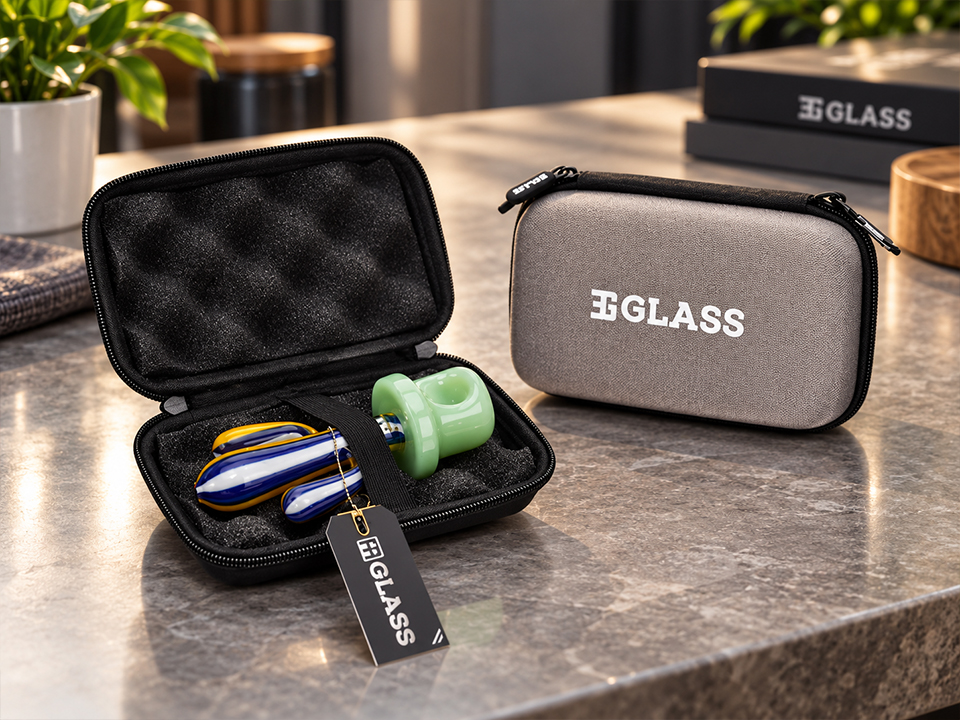
Hand pipes. Small pieces such as the yellow duck glass hand pipe (5 in, 92 g) and the trans prickly pear bonsai hand pipe (6.5 in, 109 g) have short paths. A bag method with a small amount of salt is usually practical. The bonsai piece has hand-made dotted details that crystals may not reach evenly.
What Should You Verify Before Stocking a Glass Piece or Writing Care Guidance?
Care guidance works best when it matches the geometry of the piece. These checks help a buyer avoid a mismatch:
- Ask for internal opening sizes. Request photos or dimensions of the narrowest passages, such as downstems, percolator slits and joint openings. Compare them against the salt grade you plan to recommend.
- Ask how decorations are made. Find out whether figures and accents are fused glass or attached with adhesives or coatings. Ask whether the supplier has any guidance on alcohol exposure.
- List non-glass parts. Silicone, rubber o-rings, plastic clips and bags can react with alcohol. Separate instructions for those parts reduce confusion.
- Run a retention test on a sample. Before ordering, clean a sample with salt and rinse it, then inspect narrow passages for trapped crystals and check that colour or decoration is unaffected.
- Write the care card precisely. Name the salt type (coarse, food-grade sodium chloride), the alcohol grade (commonly 91% or higher), the ventilation and flame warnings, and the rinse step. State which parts and materials the method does not suit.
A supplier that can answer these questions, and send sample photos of internal geometry, is easier to plan around than one that cannot.
Frequently Asked Questions
Does salt scratch a glass bong?
Salt should not scratch clean borosilicate. Halite rates about 2.0–2.5 on the Mohs scale, while borosilicate is commonly given about 6, though published values vary. Harder grit, such as sand, can scratch, and shaking can chip glass.
Why use coarse salt instead of table salt?
Coarse crystals are larger and heavier, so each contact carries more force, and their edges scrub more effectively. Fine table salt makes many gentler contacts and dissolves faster. Coarse salt is generally preferred for open chambers but can lodge in narrow passages.
Can Epsom salt replace sodium chloride?
Many cleaning guides recommend it. Epsom salt is magnesium sulfate, not sodium chloride, so it is a different compound with its own hardness and solubility. Both rely on staying undissolved in alcohol. Test it on a sample before putting it in care guidance.
Why does 91% or 99% isopropyl alcohol work better than 70%?
Higher grades contain less water. Water dissolves salt, which shrinks the crystals, and a watery mixture dissolves resin less effectively. IPA can also separate from salt solutions, so a lower grade may weaken both solvent and abrasive.
Does salt cleaning work inside percolators and recyclers?
Only partly. Crystals cannot reach slits, enclosed chambers or internal figures well, so cleaning there depends mostly on the alcohol soak. Check opening sizes and internal geometry before assuming the method will suit a design.
Can I use alcohol and salt on silicone or acrylic?
Not without caution. IPA can swell and degrade silicone over time, and salt is harder than many plastics, so it may scratch acrylic. Use a method the maker recommends for those materials.