Free shipping in the U.S. for orders over $50

Find Your Perfect Bong: Style, Quality & Value
For a smoke shop, distributor or online retailer, the perfect bong is not a single product. It is a range that suits how your customers shop, survives freight, and still earns margin after breakage and returns. Buyers who choose from photos and unit price often find the real differences only when cartons arrive. Wall thickness varies between batches, bowls fit loosely, and bases wobble. This guide covers how to match bong styles to customer segments, what “quality” means in practical glass terms, how to compare value beyond the quoted price, which compliance questions to settle early, and what to put in an RFQ. Product examples come from specifications published on EG Glass pages.
Which Bong Styles Belong in a Wholesale Range?
Most retail ranges need three roles: a full-size anchor piece, a filtration-led upgrade, and a compact entry piece. The table compares five styles using the specifications EG Glass lists for its clear glass models. The “Trade-offs” column is qualitative guidance, not measured data.
| Style | Listed height / weight | Where it fits | Trade-offs to weigh |
|---|---|---|---|
| Full-size water pipe with removable bowl | 10.6 in / 611 g | Anchor piece for home-use shelves | Heaviest listed piece, so higher freight and transit-breakage exposure |
| Percolator water pipe | 7.9 in / 458 g | Customers asking for added diffusion | More internal glasswork to inspect and clean |
| Recycler with cyclone perc | 8.4 in / 353 g | Shoppers who want visible water movement | Complex internal path, so quality-control checks matter more |
| Mini bubbler | 5.1 in / 216 g | Entry price point, compact displays | Less water volume and filtration |
| Mini hookah with percolator | 8.3 in / 447 g | Compact format with a diffusion feature | Side-mounted bowl joint needs a fit check |
Full-size anchor pieces
A full-size piece such as the clear glass bong water pipe with a removable bowl works as the visual centre of a shelf. Its page describes a flared round base, a bell-shaped chamber and a removable bowl. A wide base matters commercially as well as functionally. Pieces that tip over on a display shelf get damaged in the store before they reach a customer.
Filtration-led designs
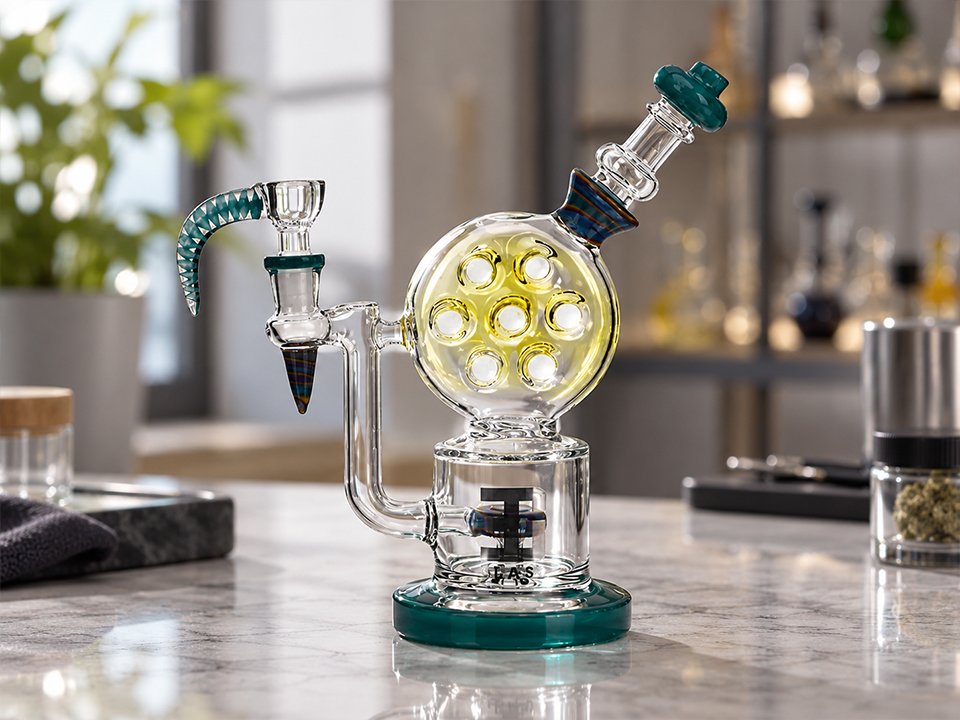
Buyers who want to offer more diffusion can compare the clear glass percolator water pipe with a disc base with the full-size clear glass recycler dab rig with cyclone perc. Both add internal structure. That gives a clearer product story but also more points where weld quality can vary.
Compact entry pieces
Smaller formats lower the price barrier. The clear glass bubbler water pipe lists fixed internal diffusion and a removable funnel-style bowl. The clear mini hookah with a bent neck and percolator adds an internal percolator chamber in a compact body. Both can suit buyers testing a new market or building an affordable “starter” tier.
What Makes a Bong “Good Quality” in Glass Terms?
Quality is not one attribute. For a wholesale buyer it comes down to four checkable factors: glass type, wall thickness, joint and weld integrity, and annealing. Each can be requested in writing and verified on a sample.
Glass type: why borosilicate is the usual specification
Borosilicate is the standard material for quality water pipes because it tolerates temperature change better than ordinary glass. The common laboratory type has a thermal expansion coefficient of 3.3 × 10⁻⁶ K⁻¹, about one-third that of soda-lime glass. That lowers the stress caused by temperature gradients, such as hot water followed by a cold rinse.
The “3.3” label refers to that coefficient. A borosilicate 3.3 explainer from John Morris Group notes that the grade is also known as Type 1, Class A under ASTM E438. That is a laboratory-glass designation. Bong factories may source tubing differently, so ask which glass grade and tubing supplier a model uses rather than relying on descriptive wording. Phrases such as “scientific glass”, “lab-grade” or “borosilicate-style” describe appearance or marketing. They do not specify a material. Ask for a written statement of the glass type for each SKU.
Wall thickness: what it changes and what it does not
Thickness affects weight, feel and impact tolerance. It does not guarantee smoother performance or immunity to breakage. A retailer guide on what 5 mm, 7 mm and 9 mm walls change makes the same distinction. Thicker walls give more heft and take bumps better, but they do not make a piece smoother or unbreakable. It also points out that thermal shock can still crack thick borosilicate. Treat that as a retailer’s view, not an independent test.
For buyers, the practical rule is to specify thickness by component. Request the wall thickness of the tube, the base and the neck, in millimetres. Then compare the sample’s weight and measurements against the catalog figures. The EG Glass pages publish height and weight but not wall thickness. A heavier piece is not automatically a better one, so ask for the thickness figures.
Annealing, joints and fit
Glass that has not been properly annealed can hold internal stress and crack later without obvious damage. A quick sample inspection should cover:
- Evenness of wall thickness around the tube and at the neck-to-base transition.
- Smooth, continuous welds with no pinholes or visible stress lines.
- Bowl or downstem seating that is snug without being forced.
- A flat base that stands level on a countertop.
- Mouthpiece rims that are fire-polished, not sharp.
Percolators: diffusion, drag and cleaning
A percolator or recycler adds diffusion but also airflow resistance and more surfaces to clean. More internal structure means more welds to inspect and more places for residue to collect. Choose the percolator type by customer segment, not by complexity alone. Customers looking for easy cleaning and low drag may prefer a simpler design.
Is Thicker Glass or a Lower Price Better Value?
Neither the thickest piece nor the lowest quote is automatically the best value. The right answer depends on your freight costs, your breakage tolerance and who buys the piece.
Unit price tells you what the glass costs. It does not tell you what arrives sellable. Here is an illustrative calculation, not real data. Quote A is $9.00 per unit with 8% of units lost to breakage or rejection. Quote B is $9.60 per unit with 1.5% lost. Dividing price by the share of usable units gives an effective cost of about $9.78 for Quote A and about $9.75 for Quote B. The cheaper quote has no advantage, and the arithmetic leaves out replacement freight, return handling and lost customer goodwill.
Thicker walls add weight, and weight adds freight. The carton data on EG Glass pages shows how format affects shipping density. The figures below are calculated from the listed pieces per carton and piece weight. They exclude packaging weight and assume carton dimensions of 60×40×45 cm.
| Model | Pieces per carton | Glass weight per carton (approx.) | Carton volume per piece (approx.) |
|---|---|---|---|
| Full-size water pipe (10.6 in) | 34 | 20.8 kg | 0.0032 m³ |
| Percolator water pipe (7.9 in) | 40 | 18.3 kg | 0.0027 m³ |
| Recycler with cyclone perc (8.4 in) | 35 | 12.4 kg | 0.0031 m³ |
| Mini hookah with percolator (8.3 in) | 50 | 22.4 kg | 0.0022 m³ |
| Mini bubbler (5.1 in) | 75 | 16.2 kg | 0.0014 m³ |
A mini bubbler occupies roughly 45% of the carton space that a full-size piece does, so freight per unit is lower. The trade-off is lower perceived value. A mixed assortment usually balances these formats better than a single-style order. Whether that holds for your market depends on your own sell-through data.
Should Hand Pipes and Nectar Collectors Sit Beside Bongs?
Compact accessories can lift basket value and give lower-priced options to customers who are not ready for a full-size piece. They also pack densely. The colorful glass spoon hand pipe lists 150 pieces per carton and five colour options. The clear glass hand pipe with a side bowl gives a minimal clear alternative. A grenade-shaped glass hand pipe is a novelty line that may suit gift-oriented displays. Novelty shapes can age faster than classic ones, so keep novelty orders smaller until you see sell-through.
Nectar collectors are a separate category aimed at concentrate users. EG Glass lists several pull-and-clean designs:
- The pull-and-clean nectar collector dab straw kit has a faceted cone chamber and a detachable tube, packed in a window box.
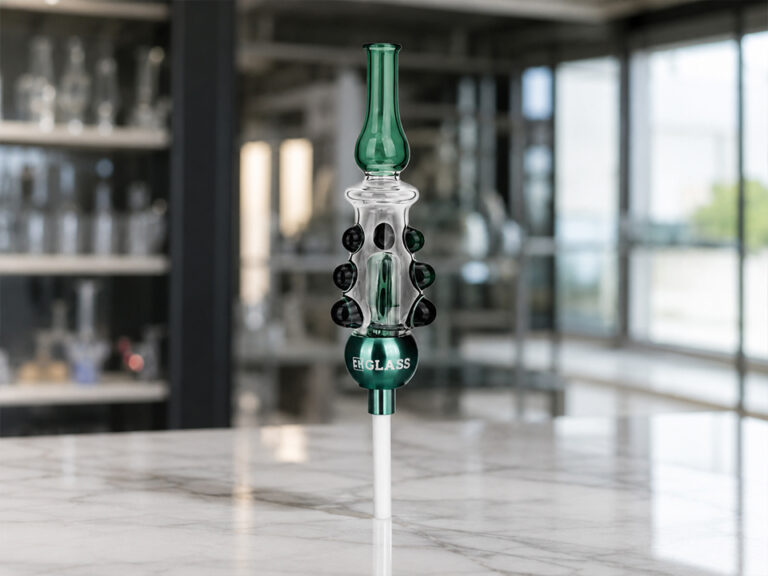
- The portable glass nectar collector uses an hourglass chamber and coloured accents.
- The pull-and-clean glass nectar collector with a removable 510 thread part lists a 510 ceramic tip.
- The bowling pin nectar collector is a novelty shape with retail window-box packaging.
When comparing these, ask which parts are removable and which are replaceable. Check how the tip attaches and how packaging protects the glass in a mixed carton.
What Compliance Questions Should You Settle Before Importing Bongs?
Rules for water pipes and related products vary by country, state and locality, so check them before you place an order. Nothing in this section is legal advice.
In the United States, federal law defines drug paraphernalia in 21 U.S.C. § 863. The definition covers equipment “primarily intended or designed” for use with controlled substances, and its examples include glass pipes and water pipes. The statute exempts persons authorized by local, state or federal law to manufacture, possess or distribute such items. It also exempts items traditionally intended for use with tobacco products that are sold in the normal lawful course of business. It lists factors such as the ratio of sales to total business sales and the existence of legitimate uses in the community.
Practical questions for a buyer to settle with counsel or a compliance adviser include:
- Which product categories are lawful to import and sell in the destination market?
- What age verification and sales-channel rules apply, online and in store?
- How do product descriptions and marketing claims fit local rules?
- Does the destination market require any labelling or customs documentation?
What Should You Specify in an RFQ for Glass Bongs?
An accurate quote needs more than a model name. Missing details lead to substitutions, delays and disputed deliveries.
| RFQ field | Why it matters | What to state |
|---|---|---|
| Model and height | Sets glass volume and freight | SKU, height, any tolerance you accept |
| Glass type | Affects thermal resistance | Required glass type, confirmed in writing |
| Wall thickness | Affects weight, feel and breakage | Thickness by component, in mm |
| Bowl and joint fit | Prevents loose or stuck parts | Bowl type, fit requirements, spare bowls |
| Colour and finish | Affects consistency across batches | Colour names, an approved sample |
| Packaging | Controls transit damage and shelf appeal | Window box, bulk pack or private-label box |
| Quantity mix | Affects MOQ and carton planning | Pieces per style, mixed-carton rules |
| Inspection and breakage terms | Defines the remedy for damaged goods | Pre-shipment photos, claim window |
| Delivery terms | Determines landed cost | Incoterm, destination, timeline |
| Compliance documents | Avoids customs or sales delays | Any paperwork your market requires |
What Should You Verify Before Placing a Bulk Order?
Before you commit to volume, work through these steps.
- Request samples of the exact SKUs, not look-alikes. Measure height and weigh each piece, then compare the results with the catalog data.
- Inspect the glass. Look for weld quality, base flatness, bowl fit and even walls, using the checks above.
- Ask for written specifications. Get the glass type and component thickness for every SKU.
- Test the packaging. Review how pieces are separated inside the carton, especially in mixed assortments.
- Confirm commercial terms. Ask about MOQ, mixed-order rules, lead time, private-label options and breakage claims. EG Glass pages do not publish these, so confirm them directly.
- Run a small first order. Check sell-through and breakage before scaling up.
Frequently Asked Questions
What is the best glass for a bong? Borosilicate is the usual choice. Its thermal expansion coefficient is about one-third that of soda-lime glass, so it handles temperature changes better. Ask the supplier to confirm the glass type in writing for each SKU.
Is thicker glass always better? No. Thicker walls add weight and take bumps better, but they do not guarantee smoother performance or prevent thermal shock. Weigh thickness against freight cost, price and how customers actually use the piece.
How do I compare two wholesale bong quotes? Compare effective cost, not unit price. Account for breakage or rejection rates, freight per piece, packaging, and the glass type and wall thickness quoted. Order samples of the same SKU from each supplier before choosing.
Which bong style is best for a new retail range? A mix usually works best: one full-size anchor piece, one percolator or recycler for customers wanting more diffusion, and a compact bubbler for entry pricing. Adjust the balance using your own sales data.
What should an RFQ for glass bongs include? Include the model and height, glass type, wall thickness by component, bowl fit, colour, packaging, quantity mix, inspection and breakage terms, delivery terms, and any compliance documents your market requires.
Are bongs legal to import and sell? It depends on the country, state and local rules, and on how products are described and sold. In the US, federal law defines drug paraphernalia and includes exemptions. Consult counsel before importing.