Free shipping in the U.S. for orders over $50

Specs Buyers Need Before Ordering Ash Catchers at Scale
Most buyers guess. And that is exactly why so many “good-looking” wholesale ash catcher orders arrive with mismatched joints, crooked welds, thin glass at the stress points, and cartons that feel like they were packed by someone who has never paid a chargeback in their life. Why are people still wiring deposits off two glamor shots and a unit quote?
I’m blunt about this because I’ve seen the same mistake on repeat: buyers obsess over per-piece cost and ignore the boring numbers that actually decide whether the order survives transit, fits the host piece, and gets reordered. In 2024, Reuters noted the U.S. cannabis market was projected around $40 billion, with recreational use legal in 24 states by that point, which means accessory buyers are not operating in a hobby corner anymore; they are operating in a real, scaled retail channel.
But growth does not equal safety. Federal law still defines drug paraphernalia broadly under 21 U.S.C. § 863, and Reuters reported in April 2024 that the Justice Department’s move toward rescheduling cannabis did not erase the wider compliance tension around cannabis-adjacent products, packaging, and shipment exposure. If you buy at scale, you need a spec sheet and a paper trail, not just a prettier invoice.
Table of Contents
The joint spec is where bulk orders go to die
Three numbers matter. Joint size, joint gender, and joint angle sound basic, but this is where factories hide behind buyer vagueness, because “14mm ash catcher” is not a full spec any more than “black SUV” is a vehicle order, and the missing details are exactly what create returns. How many buyers write “14mm” and forget to lock male/female, 45°/90°, insertion depth, and ground-joint tolerance?
If I were placing a serious PO, I would refuse to approve any ash catcher without these locked in writing: 14 mm or 18 mm, male or female joint, 45° or 90° angle, and a tolerance note for joint seating. The difference between a clean fit and a customer forcing a joint until it snaps can be less than a millimeter. That is not theory. That is margin.
And yes, catalog context matters. If your assortment leans toward compact or bent-neck rigs, a 45° unit often makes more sense next to a Swiss perc bent neck dab rig or an 8.6-inch borosilicate dab rig, because the geometry is less awkward on angled stems. If you sell more upright pieces, a 90° ash catcher tends to sit cleaner beside a 10-inch borosilicate concentrate rig. Fit is not a side note. Fit is the product.

Borosilicate 3.3 is not a luxury line item
Cheap glass lies. Suppliers love saying “borosilicate” the way bad restaurants say “artisan,” which is to say they know the word sells, but they hope you never ask what thickness was used at the joint, how even the wall profile is, or whether the weld line was flame-polished well enough to avoid stress concentration. Why would you trust a material claim that arrives with no wall-thickness range and no close-up of the joint collar?
My view is simple: for wholesale ash catchers, “borosilicate 3.3” should be the floor, not the upsell. And even then, I care less about the label than the execution. I want the joint reinforced, the chamber balanced, and the weld line consistent. I also want the supplier to confirm whether the piece is hand-finished or mold-assisted, because that changes both visual uniformity and breakage behavior.
This is also where a lot of buyers get seduced by novelty. I like a flashy catalog as much as anyone, but if you are pairing ash catchers with visually loud pieces such as a spinning spaceship borosilicate dab rig or a spinning NBA jersey borosilicate rig, the supporting accessory has to be even more disciplined on tolerance and weld strength. Decorative catalogs create more impulse buying. They also create more customer handling, more shelf movement, and more accidental knocks.
Angle and chamber design decide whether customers rebuy or refund
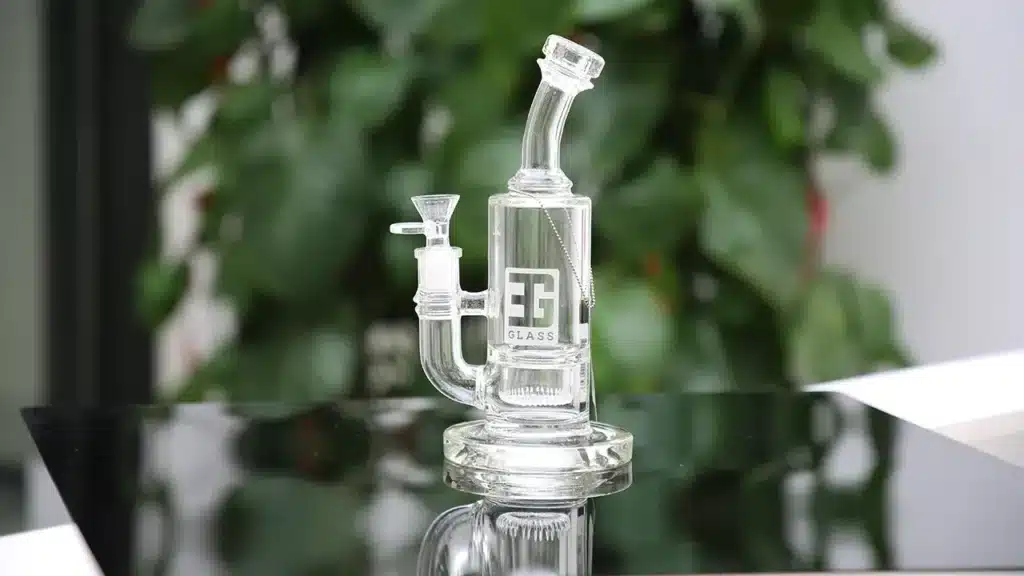
Airflow is sales. A bulky chamber with sloppy diffusion can look premium on a sample table and still sell like a brick once real customers put it on a rig, because drag, splashback, and cleaning frustration destroy repeat demand faster than a mediocre photo ever will. So why do buyers keep rewarding suppliers who optimize the silhouette and ignore the smoking experience?
Here is the hard truth: most end customers do not talk in factory language, but they absolutely notice the output. They notice whether reclaim builds too fast. They notice whether the piece makes the rig top-heavy. They notice whether the pull feels choked. So your ash catcher spec has to include chamber diameter, approximate capacity, perc type, and center-of-mass balance when attached.
I prefer buyers to segment their order by host-piece family, not by one-size-fits-all optimism. A smaller, cleaner-profile ash catcher will make more sense for compact pairings such as that 8.6-inch borosilicate dab rig, while a taller or more visually assertive setup can handle a different silhouette near a Swiss perc bent neck dab rig or a 10-inch borosilicate concentrate rig. Bulk buying without end-use mapping is lazy buying.

Packaging math can erase your margin faster than bad glass
Margins vanish fast. In January 2024, Reuters reported Asia-to-U.S. East Coast shipping rates climbed 55% to about $3,900 per 40-foot container, and by late May Reuters reported China-to-U.S. East Coast spot rates had reached $6,061, while China-to-North Europe hit $4,615. When freight moves like that, weak carton design is not a packaging problem; it is a finance problem.
This is why I get impatient when factories say “safe packing” and leave it there. I want the exact unit pack, divider structure, master-carton count, drop-test standard, carton burst rating, and whether the joint is immobilized or allowed to rattle inside a thin foam sleeve. Do you really want to discover your supplier’s definition of “export pack” after 11% of the shipment arrives with hairline fractures?
For wholesale ash catchers, I would ask for each inner box to lock the joint and chamber separately, EPE or equivalent foam density to be stated, dividers between units, and a master carton that does not chase density at the expense of crush resistance. My default suspicion is that the cheapest quote is often the one that quietly assumes you will absorb the breakage.
The spec sheet I would demand before sending a deposit
A real spec sheet is a control document. It should tell you exactly what is being made, how tightly it is being made, how it is being packed, and what defect threshold the factory is expected to hold, because once money leaves your account, “we thought you meant” becomes the costliest sentence in the transaction. Why are so many buyers still approving samples without converting them into a written production standard?
Here is the minimum framework I would use before placing a volume order.
| Spec Area | Minimum acceptable for bulk orders | Better target for serious buyers | Why it matters |
|---|---|---|---|
| Joint size | 14 mm or 18 mm clearly stated | Dual-SKU split by catalog demand | Prevents fit complaints and returns |
| Joint gender | Male/female listed on PO and carton | Labeled on unit box and master carton | Stops warehouse picking errors |
| Joint angle | 45° or 90° locked before sampling | Angle verified with host-piece test fit | Reduces mismatch with rigs |
| Glass material | Borosilicate stated | Borosilicate 3.3 with reinforced joint area | Better heat and stress handling |
| Wall thickness | Range stated | Tolerance stated at chamber and joint collar | Thin spots are breakage magnets |
| Perc / chamber | Type and chamber size listed | Splashback and airflow tested on sample | Affects customer experience |
| Weld quality | Visual inspection only | Close-up approval photos plus QC standard | Weak welds fail in transit or use |
| Packaging | Foam sleeve + carton | Joint immobilization, dividers, drop-tested export carton | Protects margin under volatile freight |
| QC threshold | “Factory standard” | AQL target written into PO | Makes claims enforceable |
| Labeling | Plain sticker | SKU, angle, size, gender on every box | Reduces reseller confusion |
The buyers who win this category are not the ones with the lowest quote. They are the ones who force ambiguity out of the transaction before production starts.

FAQ
What specs matter most when ordering ash catchers at scale?
The most important ash catcher specs for bulk ordering are joint size, joint gender, joint angle, borosilicate grade, wall thickness, chamber design, and packaging standard, because those seven variables decide fit, breakage rate, shelf appeal, return risk, and whether your second order is smoother or a total headache. I would add one more: carton labeling. Bad labeling creates silent warehouse errors that look like product defects.
Should wholesale buyers stock 14mm or 18mm ash catchers first?
The best wholesale sizing strategy is to stock the joint size that matches the dominant installed base in your own catalog and customer mix, which usually means 14 mm for faster-turn modern assortments, while 18 mm still matters for shops serving buyers who prefer larger rigs and older standard setups. My bias? Carry both, but do not split inventory evenly unless your sales data says you should.
Is 45 degree or 90 degree better for an ash catcher?
The better ash catcher angle is the angle that matches the host piece’s stem geometry, with 45° usually fitting angled downstems and 90° usually fitting vertical connections, because angle mismatch creates unstable balance, awkward orientation, and customer complaints even when the glass itself is perfectly made. If a supplier cannot show the angle clearly in side-profile photos, I assume trouble.
How should a factory pack ash catchers for wholesale shipment?
Proper wholesale ash catcher packaging means each unit is immobilized at the joint and chamber, separated from adjacent units, packed in a labeled inner box, and then loaded into a crush-resistant export carton with documented drop protection, because fragile glass fails from movement, not just impact. I also want carton count optimized for claims control, not merely cube efficiency.
What is the safest way to approve an ash catcher supplier?
The safest supplier-approval method is to convert the approved sample into a written production specification with measured dimensions, packaging requirements, QC thresholds, and defect-photo standards, because a sample without a matching spec sheet gives you almost no leverage once mass production starts. Samples prove possibility. Documents prove accountability.
You do not need more supplier promises. You need tighter buying discipline, uglier questions, and a refusal to approve vague glass. If you are building an accessory catalog around borosilicate pieces, pair your ash catcher program with host products that make sense on fit and angle, whether that is a Swiss perc bent neck dab rig, a 10-inch borosilicate concentrate rig, or a more visual SKU like the spinning spaceship borosilicate dab rig. Buy like the breakage is yours. Because it is.