Free shipping in the U.S. for orders over $50

Post-Clean Inspection Checklist for Glass Bongs and Rigs
A bong that looks clean is not automatically ready to use, display, or resell. Cleaning removes the residue that hides chips, hairline cracks, and worn joints. Inspection is the step that decides whether the piece goes back into service. For smoke-shop operators, distributors, and quality teams who handle demo units, customer returns, or inbound stock, a repeatable post-clean inspection reduces breakage claims, protects customers from sharp edges, and keeps product photos honest. This checklist explains what to inspect after cleaning a glass bong, dab rig, hand pipe, or nectar collector, how to order the checks, how priorities change by piece type, and what to document with your supplier.
Why Inspect After Cleaning Instead of Before?
A post-clean inspection is a structured check of a cleaned, fully dry glass piece for residue, cracks, chips, joint wear, airflow blockages, and stability. It happens after cleaning because resin and mineral film hide defects, and because the cleaning process itself can create or expose them.
Three mechanisms make the post-clean moment the right checkpoint:
- Residue masks damage. A chip on a bowl rim or a hairline crack near a joint is easy to miss under a film of buildup.
- Temperature change stresses glass. A technical note on borosilicate thermal shock behaviour explains that a temperature gradient creates internal stress, and that a crack can start at a surface flaw, scratch, sharp corner, or stressed joint. Hot rinse water on a cold piece, or cold water on a warm one, is exactly that kind of event.
- Handling risk peaks during cleaning. Wet glass is slippery, and shaking a sealed piece with abrasive salt is a physical stress that dry display or storage never creates.
Laboratory glassware guidance follows the same logic. One supplier guide on borosilicate best practices in the lab recommends checking for cracks, chips, or scratches before and after every use. Bongs and rigs are not laboratory vessels, and the glass type varies by product, so treat that guidance as a sound inspection habit rather than a specification.
How to Set Up the Inspection Station
Before looking at any piece, make sure it is ready to inspect.
Dry and odor-free. Isopropyl alcohol is the usual solvent in bong cleaning, and it is hazardous when left behind. The safety data sheet for 99% isopropyl alcohol classifies it as a highly flammable liquid and vapor and advises use in a well-ventilated area. A published isopropyl alcohol and salt cleaning guide advises rinsing until no alcohol smell remains, then air-drying completely. For inspection purposes, a piece that still smells of alcohol once dry fails the first gate and goes back for another rinse.
Light and backgrounds. Use bright, diffuse light, plus a dark background and a light background. Fine cracks show as bright lines against dark, while residue and haze show better against light. Add a small magnifier and a flashlight for looking inside chambers.
A flat reference surface. A level tabletop is enough for the stability test.
A written log. Record SKU, batch or lot, date, inspector, findings, and disposition. Without a log, inspection findings cannot feed back into supplier conversations.
The Post-Clean Inspection Checklist
Work in this order. Each step is cheaper to run before the next one, and defects found early save time later.
1. Residue and odor
Hold the piece up to the light and look through every chamber, the downstem, the bowl, the mouthpiece, and any diffusion or percolator openings. Check inside joints, where buildup collects last.
Haze that remains after a second cleaning cycle may be mineral deposit or surface wear instead of residue. Compare it with a known-new unit of the same SKU before deciding. If the haze is on the glass surface and not in a film that wipes away, re-cleaning will not fix it.
Verify with the supplier: which cleaning agents are safe for coloured, coated, or decorated pieces. Do not assume a method that works on plain clear glass is safe on every finish.
2. Chips, cracks, and scratches
Rotate the piece slowly under the light and check the places where glass is most exposed:
- Mouthpiece rim and flared lips.
- Bowl rims and the edges of side bowls.
- The base edge or disc.
- Neck-to-chamber transitions and fused joints.
- Anywhere an internal part meets the outer wall.
Tilt each area against the dark background. A hairline crack catches light as a thin bright line. For rims, drag a cotton swab or a cloth gently along the edge. Snagged fibers reveal roughness that eyes can miss, and this is safer than running a bare fingertip over a possible chip.
Treat chips on a mouthpiece or bowl rim as a safety defect, not a cosmetic one, because they create sharp edges at the point of contact. A clear glass hand pipe with a side bowl is a good example of why rim checks matter: the flared mouthpiece and the built-in side bowl are both rim-heavy features on a compact body. The same applies to a molded novelty form such as a grenade-shaped glass hand pipe, where the rounded chamber and top bowl create more transition points to examine.
3. Bowl and joint fit
For pieces with a removable bowl, seat the bowl in its own socket and check for rattle, tilt, or rough resistance. Look closely at the joint surfaces for flaking, chipping, or uneven frosting. Test each bowl with the piece it shipped with, since mixing parts between units can hide a fit problem or create a false one.
Never force a tight bowl. Twisting a stuck joint can break the glass, so a piece that binds should be set aside and logged rather than worked free on the bench.
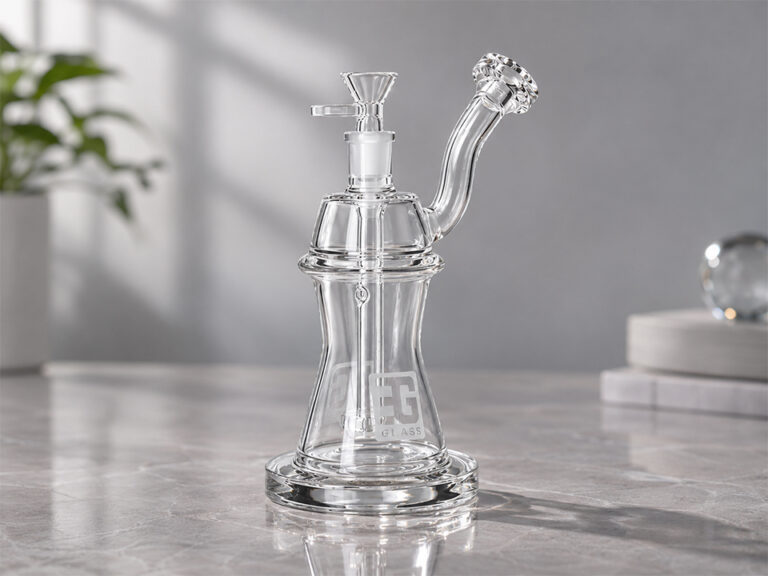
A full-size clear glass bong with a removable bowl and internal downstem is the tallest piece covered here, so its joint carries the most leverage. Its product page lists a height of 10.6 inches and a weight of 611 g, so any looseness at the bowl seat translates to more movement at the top of the piece.
Verify with the supplier: joint size, whether bowls are interchangeable across units of the same SKU, and the replacement-part policy.
4. Internal airflow and diffusion
Internal parts are the hardest areas to clean and the hardest to inspect. A water test helps. Fill the piece to its normal working level and watch for weeping at seams, joints, or any internal fusion line. Then confirm that percolator openings or diffusion slits are clear and that the water moves as expected when air is drawn through. Test airflow with a hand pump or clean tubing, not by mouth.
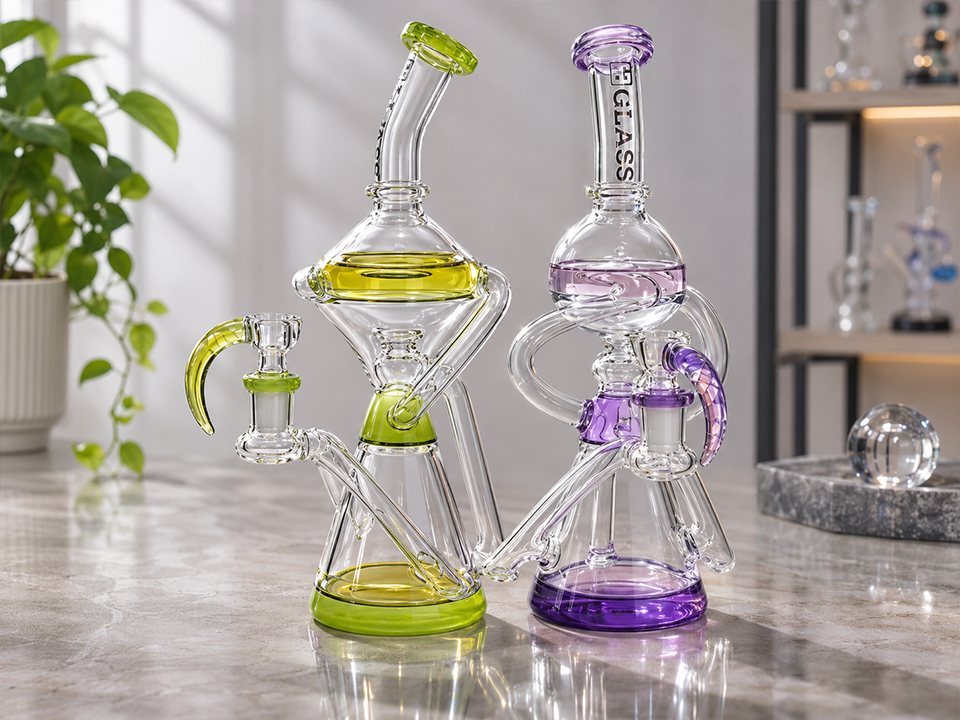
On a percolator water pipe with a disc base, the internal percolator section and the angled side joint deserve extra time. A mini hookah with a bent neck and percolator adds a side-mounted bowl to the same inspection set. A fixed internal diffuser cannot be removed for cleaning, so if residue remains in it after two cycles, the piece should be graded down or reworked rather than passed.
5. Base stability
Set the piece on the reference surface, nudge it gently from several sides, and check for rocking. An intact base can still be uneven. Compare any wobble against a known-good unit of the same SKU.
Stability matters more as pieces get taller and heavier. The product page for a compact clear glass bubbler with a removable bowl lists a height of 5.1 inches and weight of 216 g, with a flat base, so the tipping risk is lower than on a 10.6-inch, 611 g bong, but the base flatness test still applies.
6. Accessories, tips, and decorative parts
Check each removable component on its own: tips, detachable tubes, threaded sections, metal bases, and any decorative bands or colored glass sections. Inspect seating, thread engagement, and wear. Count the parts against the SKU’s component list, because a missing accessory is as much a defect as a chipped one.
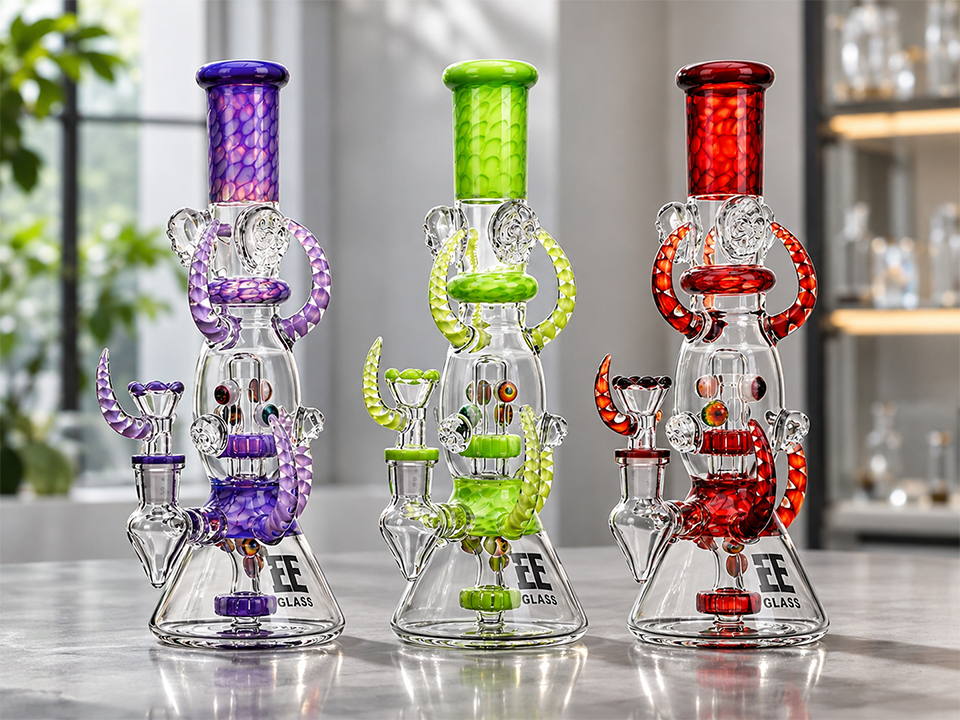
Pull-and-clean nectar collectors are built around removable components, so they need a part-by-part check. The pull-and-clean nectar collector with a removable 510 section and ceramic tip lists a removable 510-thread part and a ceramic tip. The dab straw kit with a detachable tube lists a faceted cone chamber and a detachable tube. The bowling pin pull-and-clean collector combines a removable tip with a colored body and a black band, so decoration and cleaner compatibility belong on its check list too.
How Inspection Priorities Differ by Piece Type
The checklist applies to every piece, but the weighting changes with the design. The table below shows where to spend the most inspection time. The “listed on product page” column reports only what the supplier’s product pages state; “not listed” means the page did not provide it.
| Piece type | Highest-risk areas after cleaning | Extra checks | Listed on product page |
|---|---|---|---|
| Full-size bong | Bowl seat, downstem joint, tall neck, base | Wobble at bowl seat; leak test at joints | 10.6 in, 611 g, 34 pcs/carton |
| Percolator water pipe | Internal percolator, angled side joint, disc base | Water test; slit clearance; base flatness | 7.9 in, 458 g, 40 pcs/carton |
| Bubbler | Fixed internal diffuser, funnel bowl, base | Residue in non-removable parts; bowl fit | 5.1 in, 216 g, 75 pcs/carton |
| Mini hookah with percolator | Side bowl, percolator chamber, bent neck | Water test; bowl seat | Height not listed; carton 60×40×45 |
| Hand pipe (side bowl or novelty form) | Mouthpiece rim, bowl rim, bowl junctions | Rim swab test; air path clear | Not listed |
| Pull-and-clean nectar collector | Removable tip, thread section, detachable tube, decoration | Part count; seating; cleaner compatibility | 5.87–6.5 in, 120 g, 50 pcs/carton (two listings) |
Pack quantities describe how the supplier cartons each SKU and are useful for receiving checks, but they do not predict defect rates.
Does a Harder Clean Mean a Better Result?
Some cleaning guides imply that more alcohol, more salt, and more shaking always give a cleaner piece. That is true up to a point. Beyond it, the trade-offs shift.
Coarse salt works as a mild abrasive, and abrasion is the point of using it. The same cleaning guide cautions that extended salt soaks and abrasive scrubbing can micro-pit the inside surface, which can trap future residue. That is one guide’s warning, not a measured industry figure, but it matches the general principle that scratches and surface flaws are where glass failures tend to begin.
For a retail operation, the practical conclusion is to define when cleaning stops. A shop might cap a returned piece at two cleaning cycles, then route it to a rework or discount bin if residue remains. That cap is an internal policy suggestion, not an industry standard. The principle is that a piece that needs repeated aggressive cleaning is also a piece that has accumulated more handling risk. A clean-looking piece with new surface wear can be a worse unit than a lightly stained one.
This is not an argument against thorough cleaning. A heavily fouled piece that cannot be cleaned to the written standard should not be sold as new, whatever the cleaning effort.
Pass, Rework, or Reject: Setting Disposition Rules
An inspection only helps if each finding leads to a decision. The following dispositions are suggestions to adapt into a written standard. No universal industry standard for bong cosmetic or functional grading was identified in this research, so each business should define its own and agree it with suppliers.
- Residue or alcohol smell only: re-clean, rinse, dry, and re-inspect from step 1.
- Light scratches away from rims, joints, and the airflow path: cosmetic grade, if your written standard allows it.
- Any crack, including a hairline crack or star crack: remove from sale and from use. The technical note on thermal shock and surface flaws advises that damaged glass should not be relied on in thermal duty, and a crack can travel quickly once stress is applied.
- Chip on a mouthpiece, bowl rim, or joint surface: reject for resale because of the sharp-edge risk and the joint-fit risk.
- Rattling or binding bowl, flaking joint: hold, retest with the mating part, and reject if the joint surface is damaged.
- Wobbling base: reject or grade down.
- Missing or mismatched accessory: complete the kit from verified stock or downgrade.
What Should Buyers Specify Before Requesting a Quote?
Post-clean inspection is also a way to learn which defects your supply chain produces. Inbound QC findings on new stock should feed directly into the RFQ and the supplier agreement. These are the fields that make the inspection standard enforceable:
- SKU and photos. Name the exact model and attach reference photos of an acceptable unit.
- Glass type and wall thickness. The product pages reviewed for this article do not state glass type for every item, so ask for it in writing rather than assuming.
- Annealing and strain control. Ask whether the supplier anneals finished pieces and whether it can share its inspection criteria. Do not accept a general claim of “durable” as a specification.
- Joint and bowl details. Request joint sizes and confirm interchangeability across a batch.
- Component list per SKU. List every bowl, downstem, tip, tube, and insert so receiving staff can count them.
- Finish and decoration. State colors and decoration, and ask which cleaning agents are safe for them.
- Packaging. Confirm carton configuration, inner protection, and any shipping protection program. The pack quantities on the product pages (for example, 34, 40, or 75 pieces per carton on different water pipes) show how each SKU ships, but inner cushioning is not described there.
- Defect standard and sampling. Agree a written defect list and a sampling plan for incoming inspection, and what the supplier will credit or replace if inspection fails.
- Target market and schedule. Give the destination market, expected delivery window, and shipping method so the supplier can plan packing and timing.
This article does not state any MOQ, lead time, or production capacity for EG Glass. Confirm those figures in the quotation itself.
Frequently Asked Questions
What should you check after cleaning a glass bong?
Check for leftover residue, alcohol odor, chips, hairline cracks, joint and bowl fit, internal airflow, base stability, and the condition of removable parts. Do this when the piece is fully dry, under bright light, and log findings per SKU.
Why inspect a bong after cleaning rather than before?
Residue can hide cracks and chips, and cleaning adds thermal and handling stress. Inspecting after cleaning shows the true condition of the glass and catches damage that occurred during the cleaning process.
How can you tell whether a cleaned bong has a hairline crack?
Tilt the piece against a dark background under strong light, since cracks show as thin bright lines. Drag a cotton swab along rims and joints, then run a water test and watch for weeping at seams.
How do you know all the isopropyl alcohol is gone?
Rinse until no alcohol smell remains, then air-dry completely. If the dry piece still smells of alcohol, rinse again. Isopropyl alcohol is a highly flammable liquid and vapor according to its safety data sheet.
Can cleaning salt damage glass?
Coarse salt is a mild abrasive, and one cleaning guide warns that extended soaks can micro-pit the interior surface. Limit agitation time, rinse thoroughly, and inspect surfaces afterward for new haze or scratches.
When should a cleaned piece be rejected?
Reject or remove from sale any piece with a crack, a chip on a rim or joint, a binding or flaking joint, or a wobbling base. Residue-only issues can usually be re-cleaned and re-inspected.