Free shipping in the U.S. for orders over $50

Glass Adapter Compatibility: Size, Gender, Angle, and Fit
A glass adapter either solves a mismatch or creates a new one. For wholesalers, importers, and smoke-shop buyers, most problems with joint-based glass trace back to four specification points: joint size, joint gender, joint angle, and the quality of the fit between two ground surfaces. A listing that says “14mm” answers only the first of those. This guide explains how each variable works, where nominal labels stop being reliable, how to read a product page for compatibility gaps, and what to put in an RFQ so that bongs, downstems, bowls, and adapters from one order connect and seal as intended. The examples draw on the joint specifications published on EG Glass’s own product pages.
What Does Glass Adapter Compatibility Actually Cover?
Glass adapter compatibility means that two glass parts connect, sit in the intended orientation, and seal without leaking or putting stress on the glass. Four checks decide that outcome:
- Size: the nominal diameter of the ground joint, most often described as 10mm, 14mm, or 18mm.
- Gender: whether the joint is male (it inserts) or female (it receives).
- Angle: the direction a joint points relative to the piece it belongs to, commonly 90° or 45°.
- Fit: the taper, ground length, surface finish, and tolerance that determine whether two nominally matching joints really seal.
A pair of parts has to pass all four. Size and gender are quick to verify and easy to write on a purchase order. Angle is a geometry question that matters mainly where a vessel must sit level. Fit is the check that only shows up on the bench, and it is the one most spec sheets leave out. A retailer sizing guide from DankGeek frames the first three as the core sizing factors. It also warns that mismatched angles can leave a piece sitting awkwardly or spilling concentrates.
How Do 10mm, 14mm, and 18mm Joint Sizes Work?
Retail guides generally describe 14mm as the most widely stocked joint, 18mm as the larger-bore option on bigger pieces, and 10mm as the choice for minis and small rigs. These labels are nominal. A ground joint is a tapered cone, so a single “diameter” refers to one point on that cone.
Laboratory glassware offers a useful reference. ASTM E676 covers designations, dimensions, and tolerances for the ground surfaces of interchangeable taper-ground joints used in laboratory and industrial equipment. A taper-ground joint dimension table from Wilmad-LabGlass states that mating components are finished to a 1:10 taper. It lists a 14/35 joint with a 14.5 mm large end and a 19/38 joint with an 18.8 mm large end. Those two figures match the 14.5 mm and 18.8 mm values that retail guides often quote for “14mm” and “18mm” glass. That overlap suggests the pipe-trade labels are rounded versions of those dimensions, but this is an inference. ASTM E676 is written for laboratory and industrial joints, and nothing reviewed here shows that pipe and bong makers certify to it.
Standards also come in families. DWK’s technical notes on jointed glassware explain that some product lines follow the European length requirements of ISO 383, while others follow ASTM E-676 sizes. Even in regulated lab glass, “same nominal size” does not mean “same part” across every supplier.
The practical reading for a buyer: treat “14mm” and “18mm” as shorthand, then confirm the real dimension and tolerance with the manufacturer.
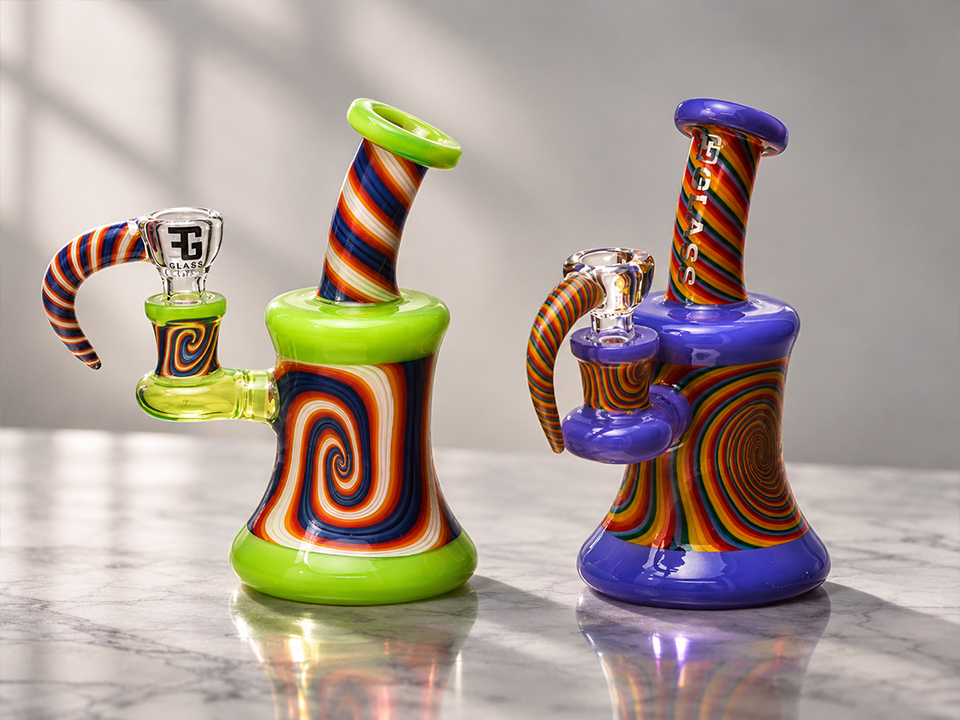
On EG Glass’s catalog, the EG-09 diamond-pattern beaker bong and the EG-08 maze beaker bong both list a joint size of “18mm Downstem 14mm Bowl,” with a 14-inch height and 7mm glass thickness. That wording points to an 18mm joint where the downstem meets the body and a 14mm joint where the bowl sits. The pages do not say which end is male or female. That detail needs confirmation before you pair these pieces with third-party bowls.
How Do Male and Female Glass Joints Pair Up?
A male joint inserts into a female joint of the same size. A female joint receives a male joint of the same size. Two males will not connect, and neither will two females.
Adapters add a wrinkle because each end has its own size and gender. Suppose a buyer wants to seat a 14mm male bowl in an 18mm female socket. The adapter needs an 18mm male end to go into the socket and a 14mm female end to receive the bowl. Naming conventions such as “18/14” or “18mm male to 14mm female” are not universal in their order. A purchase order should therefore describe both ends separately in full.
Shared specifications also simplify inventory. The EG-07 skull flower beaker bong and the EG-06 skull flower beaker bong list the same joint sizes, height, thickness, and weight (990g) as the EG-08 and EG-09. If the gender and taper are also identical, which should be verified rather than assumed, one replacement-bowl SKU can serve several body designs.
For the bowl itself, the EGB46 surfing handle bowl slide is listed with a 14mm joint size. Gender is not stated on the page. A buyer pairing it with the 14mm bowl joints above should ask the supplier to confirm it is the mating type.
Does Joint Angle Matter for Adapters and Bowls?
Yes, but not for every part. A straight slide has no angle of its own in most designs, so the angle comes from the receiving joint. Angle becomes a real specification for bangers, angled adapters, and drop-downs, where the part has to sit level or hold a vessel upright.
The common reference points are a 90° joint that points straight out parallel to the table and a 45° joint that rises at an angle. Adding an angled adapter to an angled joint changes the final orientation. The angle should be written as a number and checked against the receiving piece, not left to a photo.
Listings often skip it. The EG-05 slyme leaf beaker bong and the EG-04 triangle beaker bong list height, thickness, weight, and joint sizes, but no joint angle. That is a reason to request angle information in writing, particularly if you plan to sell matching bangers or adapters.
What Determines Fit After Size and Gender Match?
Fit is where nominal compatibility fails in practice. Four variables matter:
- Taper and ground length. Lab standards fix a 1:10 taper and define short, medium, and full grinding lengths. A shorter ground zone gives less sealing surface and less support for the attached part.
- Surface finish. A coarse or uneven grind can leak even when diameters match.
- Wall thickness near the joint. This can affect how much stress the socket handles, though it does not change the nominal size.
- Cleanliness. Residue or dust on a ground surface can cause leaks or make a joint hard to separate.
Typical failure modes are a loose joint that leaks, a joint that will not seat, a joint that sticks after use, and a chipped rim. Chipped rims often come from leverage. Every adapter in a chain adds a joint and moves weight farther from the socket. The EG-03 cross beaker bong lists a 15-inch height and 1,100g weight, against 990g for the 14-inch models. Taller, heavier bodies place more load on the same joint size, so adapter stacking deserves more caution there. The EG-02 symbols beaker bong and EG-01 clock beaker bong carry the same joint listing, which makes them useful candidates for a shared mating test.
| Checkpoint | What to confirm | Typical symptom if wrong | What to put in the RFQ |
|---|---|---|---|
| Size | Nominal size and measured dimension at the joint | Loose and leaking, or will not enter | Size for every connection point, plus the reference part or drawing |
| Gender | Male or female at each end | Parts physically cannot connect | “Male” or “female” written out for each end |
| Angle | 90°, 45°, or other, relative to a stated datum | Bowl or banger sits tilted | Angle in degrees with a reference drawing |
| Taper and ground length | Taper ratio and grind length | Poor seal or shallow seating | Required taper and grind length, or approval of a physical sample |
| Surface finish | Smooth, even grind | Leaks despite matching size | Visual and mating-test acceptance criteria |
| Stack height and weight | Number of adapters in the chain | Leverage chips, wobble, tipping | Maximum adapter count and a stability test, if relevant |
This table is a decision aid built from the sources and product pages above. It is not a published tolerance chart, and no numeric tolerance is implied.
When Is an Adapter the Right Fix, and When Is It Not?
An adapter is useful, but it is not a free fix. Each adapter adds a part to buy, a part to pack, one more seal that can leak, and one more place where glass can break. Retail guides often present adapters as the answer to a mismatch, and for a single consumer that is reasonable.
For a wholesaler, the better question is whether the mismatch should exist at all. If a product line is meant to use 14mm bowls, specify a native 14mm joint in the design. Adapters make more sense for mixed assortments, legacy stock, and customers who want an upgrade path.
A larger joint is not automatically better either. Retail guides describe 18mm as giving a more open airflow, and 14mm as the size with the widest accessory choice. Which one matters depends on the target market and the accessories you plan to offer.
Which Products in a Mixed Order Need Joint Checks?
Not every glass item has a ground joint. Sorting a mixed order by connection type prevents wasted effort and avoids false compatibility promises.
| Product type (from EG Glass pages) | Listed connection details | Listed size and packing | Compatibility gap to close |
|---|---|---|---|
| EG-01 to EG-09 beaker bongs | 18mm downstem, 14mm bowl | 14 inch, 990g (EG-03: 15 inch, 1,100g) | Gender, angle, taper not stated |
| EGB46 bowl slide | 14mm joint | No other size listed | Gender, angle not stated |
| Glass dab rig kit | 510 ceramic tip, silicone jar, removable 510 thread part | 6.9 inch, 199g, 60 pcs per carton | No ground joint listed |
| Full-size nectar collector kit | Removable 510 thread part, 510 ceramic tip, silicone jar | 5.08 inch, 110g, 50 pcs per carton | No ground joint listed |
| Full-size glass hand pipes | Hand-blown, no joint listed | 4.4 inch, 80g, 200 pcs per carton | None identified; no joint listed |
The glass dab rig kit with a 510 ceramic tip and silicone jar and the full-size 510 glass nectar collector kit both include a removable 510 thread part. A thread connection follows different rules from a ground joint, so do not assume a ground-joint adapter will fit either one. Confirm the connection type before promising adapter support. The full-size colorful glass hand pipes are listed without a joint, so they need no adapter planning. Their listed 200-piece carton shows the packing detail buyers should request for every joint accessory as well.
What Should Buyers Specify Before Requesting a Quote?
Before sending an RFQ for joint-based glass or adapters, prepare the following:
- Connection map. A simple diagram of which parts must connect, with size and gender at each end.
- Angle requirement. Degrees for each angled joint, with a reference drawing or photo that shows the datum.
- Interchangeability list. Which SKUs must accept the same bowl, downstem, or adapter.
- Fit acceptance method. A reference part or approved sample, plus a mating test on production pieces before shipment.
- Tolerance and taper requirements. Request the supplier’s actual figures rather than assuming a lab standard applies.
- Labeling and packing. Joint size and gender on inner labels, protective packing for ground surfaces, and units per carton.
- Order and delivery details. Quantity per SKU, color mix, target ship date, and destination.
- Market rules. Local rules on pipes and smoking accessories vary by country and state, so confirm what applies where you sell.
Send a sample order first. Cross-mate the pieces from that sample with your existing stock, record any loose or tight fits, and settle the specification in writing before a larger purchase.
Frequently Asked Questions
Can a 14mm bowl fit an 18mm joint?
Not directly. A 14mm part will sit loose and leak in an 18mm socket. An adapter with an 18mm male end and a 14mm female end can bridge the gap when the bowl is male. Confirm gender at each end.
How do I tell a male joint from a female joint?
A female joint is an opening that receives another part, like a socket. A male joint is a tube-shaped end that inserts into a socket. Male parts connect to female parts of the same size.
What does “18mm downstem, 14mm bowl” mean in a product listing?
It generally describes two joint sizes on the same piece: 18mm where the downstem meets the body and 14mm where the bowl sits. Gender and angle are usually not stated, so ask the supplier to confirm both.
Do 14mm and 18mm correspond to a formal standard?
Laboratory joints follow ASTM E676 and ISO 383, with a 1:10 taper. Their 14/35 and 19/38 sizes have large ends of about 14.5 mm and 18.8 mm. Pipe-trade labels look like rounded versions, but pipe makers are not shown to certify to either standard. Confirm with the supplier.
Does joint angle matter for a bowl slide?
Usually not for a straight slide, because the angle comes from the receiving joint. It matters for bangers, angled adapters, and drop-downs, where 45° and 90° parts sit differently. Specify angle in degrees.
How can a wholesaler check fit before a bulk order?
Request a sample set, cross-mate it with your existing bowls and downstems, and note any loose, tight, or leaking joints. Then fix size, gender, angle, and acceptance criteria in writing for production.