Free shipping in the U.S. for orders over $50

Trend Forecasting for Scientific Glass and Functional Accessories
I buy repeat behavior—and after years of watching shoppers get lured in by wild color pops, overloaded perc stacks, and “collector” talk that sounded sexy on product pages but turned into hot pulls, dirty chambers, and regret after ten sessions, I’ve stopped pretending novelty is the real engine here. It isn’t. Mostly.
And really, why would it be?
Table of Contents
The novelty tax is fading
But here’s the ugly truth: a lot of this category trained buyers to distrust it. Not glass itself. The nonsense around it. I’m talking about pieces that looked “scientific” because someone slapped on a label, even though the welds were sloppy, the center of gravity was off, and the whole thing felt one bad sink tap away from becoming expensive confetti.
So the market snapped back.
From my experience, that snapback always lands in the same place—stable form, decent wall thickness, honest function, less cosplay. That’s why a 14-inch diamond borosilicate beaker bong still makes sense, and why a 14-inch maze borosilicate beaker bong isn’t just “another beaker”; it sits right in the sweet spot where buyers want visible function without turning the whole piece into a gimmick.
It works. Usually.
The audience is also more seasoned than brands like to admit. NIDA’s 2024 update on 2023 use patterns showed cannabis use among adults 19–30 and 35–50 stayed at historic highs, and cannabis vaping among adults 19–30 remained at record highs in 2023. That doesn’t create a softer shopper. It creates a pickier one—the kind who notices drag, balance, cleaning pain, splashback, and whether a tube feels dialed or flimsy in about thirty seconds.
Why borosilicate still owns the serious end of the market
Yet this is where outsiders get lost.
They think “borosilicate” is a buzzword. It isn’t. It’s the floor. I frankly believe any brand still treating borosilicate like a premium flourish is either behind the curve or hoping the customer doesn’t know enough chemistry to ask better questions.
Here’s the simple version. Technical borosilicate families are typically built around silica (SiO2) above 80% and boron trioxide (B2O3) around 12–13%, with low thermal expansion near 3.3 × 10⁻⁶/K, which is a fancy way of saying the material has a real reputation for handling heat shifts and chemical wear better than ordinary soda-lime junk.
That matters. Still.
Because when a buyer searches scientific glass or scientific glass bong, they’re not just hunting for a tube with water in it. They’re buying an expectation: cleaner function, sturdier joints, better temp tolerance, and less chance the piece feels like a throwaway. Even style-heavy builds need that backbone. A 7mm Skull Flower beaker bong can lean decorative, sure, but the “7mm” callout isn’t fluff—it’s a confidence marker.
Concentrates changed the accessory game
And no, flower hardware doesn’t live in some sealed bubble.
That’s old thinking. The CDC’s route-of-use data makes the point pretty clearly: among surveyed adults in 2022, 15.3% reported current cannabis use; roughly 79.4% of current users reported smoking; and dabbing reached 14.6%, with vaping and dabbing showing up most often among adults 18–24. Read that again and you’ll see the real story: buyers don’t stay in one lane, so product strategy can’t stay in one lane either.
That changes everything.
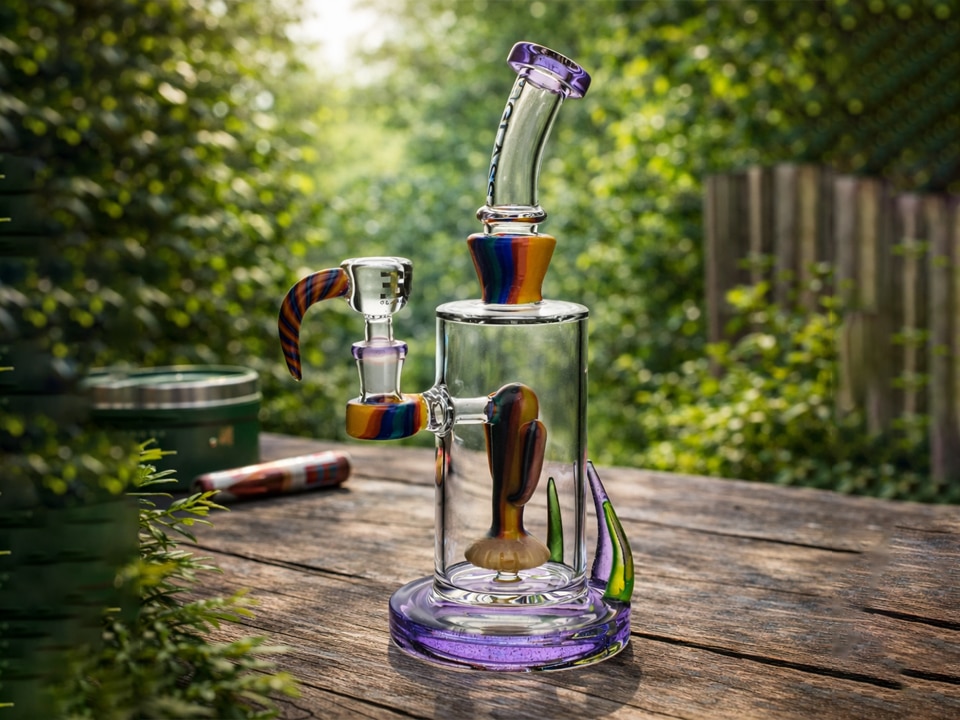
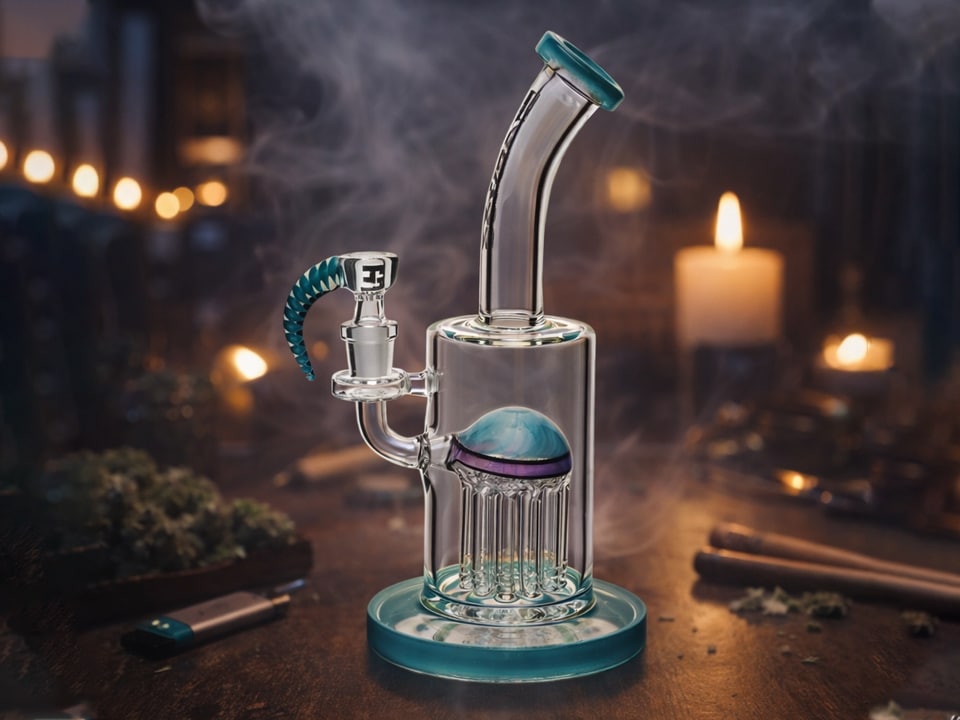
Or, fine, not everything—but enough. If your functional smoking accessories lineup still treats rigs, reclaim management, neck angle, diffusion style, and cleanability like side quests, you’re reading old charts. A glass bent-neck tree perc diffuser dab rig isn’t just another SKU in that context. It’s a signal flare. Bent neck. Tree perc. Diffuser logic. Compact enough to live on a real table without looking absurd. That’s where the smarter end of the category has been drifting.
Legal momentum is still feeding demand
But demand doesn’t wait for perfect law.
That’s another hard truth. Consumers move first, culture moves with them, and regulation lumbers in later wearing a tie and pretending it was always part of the plan. Germany is a clean example: Reuters reported in February 2024 that lawmakers approved legalization allowing adults to possess up to 25 grams and grow up to three plants, then later reported North American cannabis companies were already pushing investment toward Germany as access broadened. That kind of policy movement doesn’t just affect flower sales—it quietly expands the addressable market for better accessories, better materials, and more confident merchandising.
The U.S. signal was different, but just as loud.
In May 2024, Reuters reported the Justice Department’s formal proposal to move cannabis from Schedule I to Schedule III. No, that didn’t suddenly make every glass shop rich overnight. Don’t be naive. But it did send a confidence jolt through the category, and confidence tends to lift the better-built end before it lifts the bargain-bin stuff.

What buyers will keep rewarding
So what actually sticks?
Not maximalism. Not random “heady” chaos. Not a six-feature pitch where none of the features actually improve the rip. Buyers will keep rewarding builds where every choice can defend itself—why this chamber, why this thickness, why this silhouette, why this perc, why this angle, why this color application.
That’s why I’d keep my eye on five things, and I mean really watch them:
- 14-inch beaker formats that still deliver reliable chug, decent water volume, and a center of gravity that doesn’t make owners nervous
- 7mm thickness cues, because reassurance sells
- Rig formats that make concentrate use feel cleaner, not fussier
- restrained visual identity instead of visual overload
- botanical or geometric personalization that doesn’t sabotage airflow or maintenance
A Slyme Leaf borosilicate beaker bong works because the look is obvious without becoming clownish. A triangle borosilicate beaker bong lands for the same reason. Personality, yes. Circus act, no.
The signal table nobody in the industry should ignore
The synthesis below is built from the 2024 NIDA update, CDC route-of-use data, and Reuters’ 2024 legal reporting on Germany and U.S. federal rescheduling signals. That mix is exactly why I’m not bearish on scientific glass—I’m bearish on weak product thinking.
| 2024-2026 signal | What it really means | Likely winning product response | Example fit |
|---|---|---|---|
| Record-high cannabis vaping among adults 19-30 | Buyers are fluent across formats, so accessories must support mixed habits | More rigs, cleaner diffusion, easier maintenance | Bent-neck tree perc dab rig |
| Smoking still dominates route of use | Core water-pipe formats remain the volume anchor | Stable beakers with dependable pull and water capacity | Diamond borosilicate beaker bong |
| Dabbing is overrepresented in younger adults | Functional accessories will outperform purely decorative add-ons | Compact rigs, diffusion-forward builds, cleaner airflow | Maze borosilicate beaker bong for crossover buyers |
| Legal normalization in Europe and U.S. policy softening | Buyers get bolder about spending when stigma drops and selection widens | Higher-spec borosilicate, thicker walls, more “scientific” presentation | 7mm Skull Flower beaker bong |
| Style is still part of the purchase, but not the whole purchase | Aesthetic identity has to ride on top of function, not replace it | Color-led accents, restrained themed graphics, proven silhouettes | Slyme Leaf beaker bong and triangle beaker bong |
My forecast, stated plainly
Here’s my take.
Scientific glass isn’t drifting toward louder, stranger, more overbuilt nonsense. It’s moving toward sharper execution—borosilicate that earns the label, beaker formats that don’t try to outsmart physics, rigs that respect how people actually consume, and functional smoking accessories that solve a problem instead of inventing one.
Will weird art pieces keep moving? Sure. Some of them should.
But the best scientific glass bongs in the next cycle will be the pieces that survive real scrutiny from buyers who know what bad drag feels like, what a shaky base does to daily use, and what happens when “feature-rich” really means “annoying to clean.” That buyer isn’t niche anymore. That buyer is the market.
FAQs
What is scientific glass?
Scientific glass is borosilicate-based smoking glass built for heat resistance, structural stability, controlled diffusion, and repeat-use performance rather than decoration-first appeal, which is why the term usually points to sturdier joints, smarter chamber design, thicker walls, and a more reliable user experience over time.
That’s the clean definition. In the wild, it also signals that the buyer wants function they can feel—not just something flashy enough to photograph.
Why is borosilicate glass preferred for a scientific glass bong?
Borosilicate glass is preferred because its silica-and-boron chemistry gives it lower thermal expansion, stronger resistance to temperature shock, and better chemical durability than ordinary soda-lime glass, making it the default pick for buyers who care about lifespan, steadier performance, and fewer ugly surprises during real ownership.
And yeah, that sounds nerdy—but it matters when a piece gets used, cleaned, warmed, cooled, and handled over and over.
Are dab rigs driving growth in functional smoking accessories?
Dab rigs are driving growth because concentrate use pushes buyers toward tighter airflow control, more compact geometry, easier maintenance, and comfort-focused ergonomics, which turns so-called accessories into core hardware decisions for a market where younger adults already over-index on vaping and dabbing behavior.
That’s the bit lazy forecasting misses. Buyers don’t separate “main piece” and “functional accessory” the way old merch plans do.
How do I choose scientific glass accessories without buying junk?
Choosing scientific glass accessories means prioritizing borosilicate material, wall thickness, joint quality, silhouette stability, airflow logic, and cleaning practicality before color, branding, or trend aesthetics, because durable function predicts long-term satisfaction better than almost any hype-driven design cue in this category.
My rule is blunt: if a feature can’t explain its job in one sentence, it’s probably there to distract you.
If you want to shop the direction this category is actually moving, not the fantasy version brands pitch at trade-show speed, start with borosilicate pieces that make their function obvious, keep the gimmicks on a short leash, and build around how people really smoke and dab. The links above are a smart place to start.