Free shipping in the U.S. for orders over $50

Standard vs Custom Glass Components: A Make-or-Buy Guide
Every glass line eventually forces the same question: do you stock proven catalog designs, or do you commission pieces that only your business sells? For retailers, wholesalers, and brand owners buying borosilicate rigs, hand pipes, straight-tube bongs, and accessories such as ash catchers, the answer affects margin, inventory risk, breakage, and how easily customers can compare your price with the shop down the street. The choice is rarely all-or-nothing. Standard parts suit utility items and fast-moving shapes, while custom work pays off where visible design drives the sale and you can commit to volume. This guide explains how to tell the two apart, what drives cost and quality on each route, and what to prepare before you ask a supplier for a quote.
What Counts as Standard Glass and What Counts as Custom?
Standard glass is a catalog design produced repeatedly to the same shape, listed dimensions, and listed color options. Custom glass is any piece where you change or commission the design: a new shape, new sculpted elements, or a color scheme and branding the catalog does not offer.
In practice, buyers work across three tiers:
- Catalog stock: you buy the piece exactly as listed.
- Catalog variant: you keep a proven base and change the color, add a logo or decal, or specify your own packaging.
- Fully custom: you commission a new design, often with sculpted attachments, and agree on exclusivity and a quantity per design.
In this sector, “make” rarely means running your own furnace. It usually means commissioning production to your own design (OEM or ODM) instead of buying what the factory already offers. A retailer that operates its own glassblowing studio faces a different, capital-intensive decision that this guide does not cover.
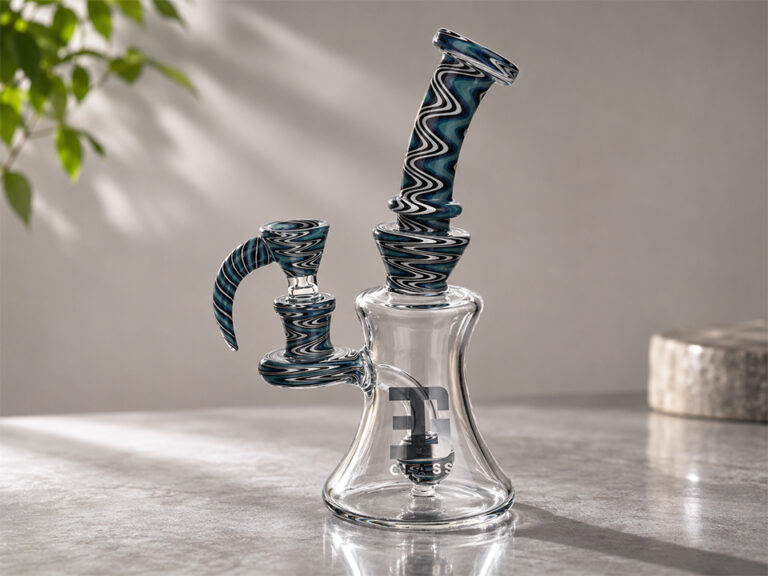
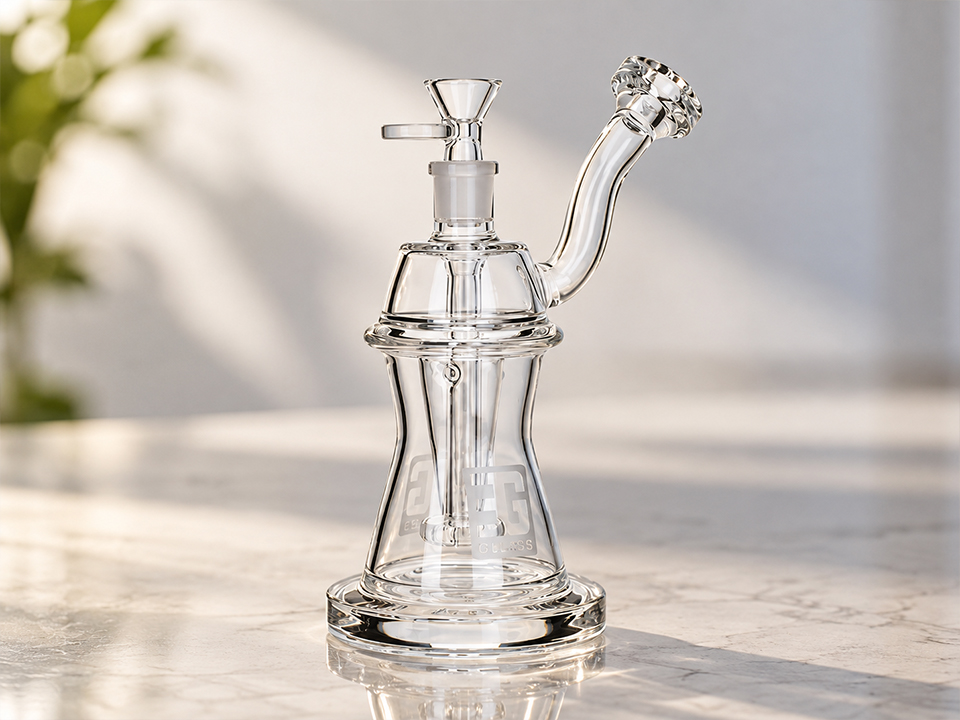
EG Glass labels several of its listings as custom, including the Custom EG-22 cactus drop rig with solid-color accents and the custom EG-21 cactus wig-wag ball rig. Both pages list the same height (7 inches), weight (248 g), and joint size (14 mm), which suggests the two designs may share a base format. The pages do not explain what “custom” covers for each listing, so a buyer exploring this route should ask which dimensions and joint details are fixed and which elements, such as accent colors or sculpted decoration, can change.
When Does Buying Standard Glass Make Sense?
Standard glass is usually the better choice for parts where fit matters more than appearance, and for simple shapes where demand is already proven.
Accessories are the clearest case. A buyer ordering something like the 90-degree, 14 mm ash catcher in the EGA10 bright horn style is mainly buying a compatible joint size and angle (the listing shows 3.74 inches in height and 106 g). Because those details are fixed and published, you can test the part against the bases you already sell before placing a larger order. Redesigning a joint adds fit risk with little commercial upside.
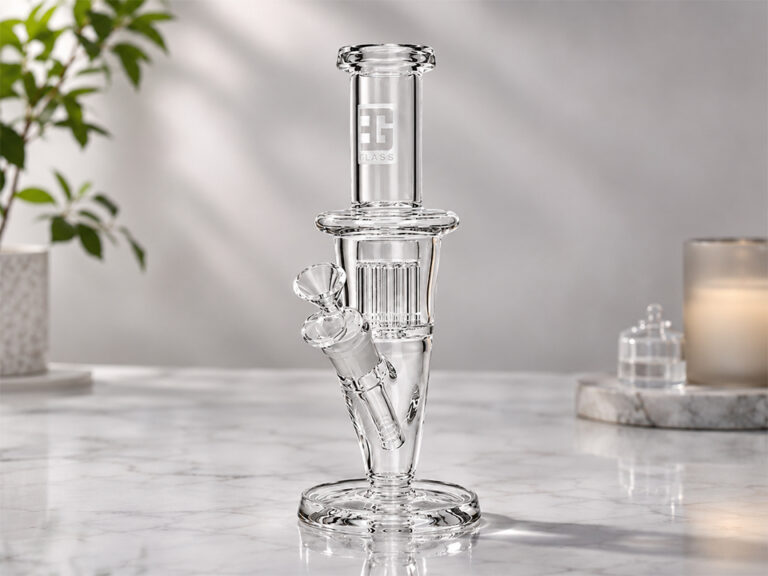
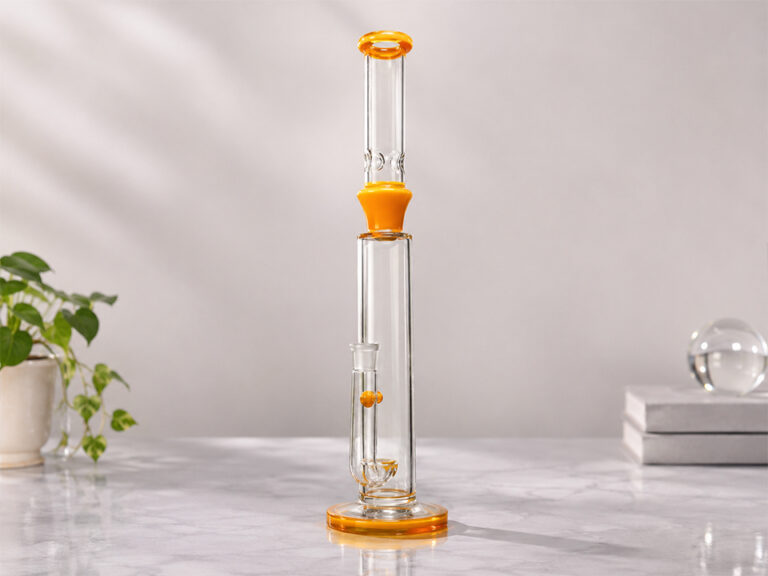
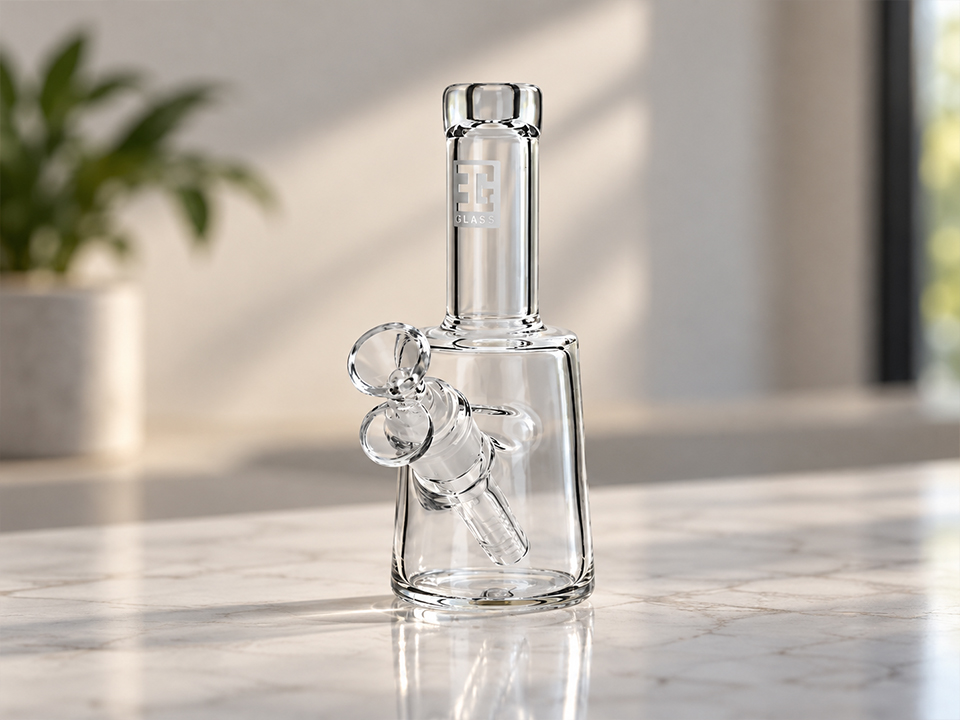
Straight-tube bongs show how one base format can carry different decoration. The 11.5-inch dual bullet water tube and the EG-35 wig-wag bullet straight tube both list 11.5 inches, a 14 mm joint, and 621 g, and differ in the decorative element. A buyer unsure which look will sell can stock both catalog designs, track sell-through, and only then consider a commissioned variant.
The same logic applies to catalog dab rigs such as the ES24834 borosilicate dab rig, which lists a 14 mm joint and 450 g. If a rig already fits a price point on your shelf, a custom version has to beat it on sell-through, not just on novelty.
The trade-offs of standard glass are real:
- No exclusivity. Any competitor can stock the same item, so price comparison is easy.
- Limited control. You accept the supplier’s shape, colors, and finish.
- Less brand equity. A catalog piece rarely tells customers anything about your business.
When Does Custom Glass Earn Its Cost?
Custom glass pays off when the visible design is the reason customers buy, you can commit to a quantity per design, and you can sell through it within a defined window.
Themed series are one effective format. The Bonsai line repeats a pot-and-plant concept across several designs: the BSH13 transparent cactus pot hand pipe lists 5.5 inches, the BSH12 cactus honeycomb pot hand pipe lists 4.7 inches, and the cherry tree pot hand pipe also lists 4.7 inches. One concept produces several SKUs that can be merchandised as a set, which is how a custom program builds recognition without relying on a single hero piece.
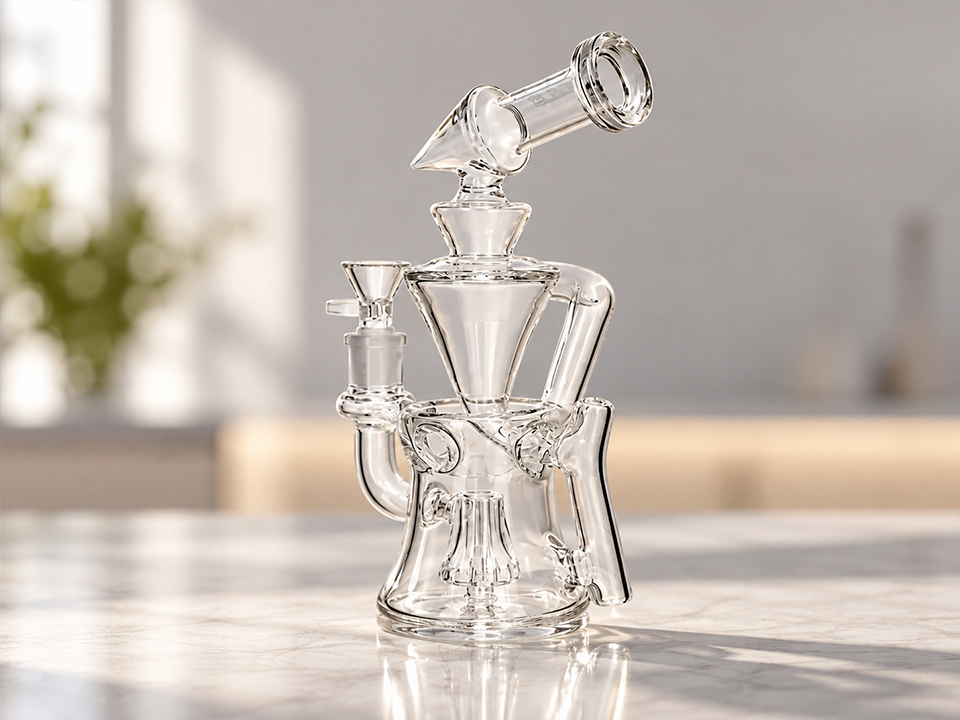
Character and sculpted pieces are the other format. The custom BSH06 rainbow series mushroom hand pipe and the yellow duck EGH26 borosilicate hand pipe sell on their design. So does the EG-60 reef rig with 3D sea-life figures. That rig lists 650 g against 450 g for the ES24834 at a similar listed height, a visible reminder that sculpted work typically means more glass, more hand labor, and more places for something to go wrong.
Does custom always mean better differentiation?
Not necessarily. Custom is often assumed to mean unique, and unique to mean higher margin. That holds only when customers buy the design itself. A custom piece that sells slowly ties up cash in stock that cannot be returned to a catalog, and each sculpted attachment adds a joint where stress can build (see the next section). For many shops, a catalog base with a distinctive color or packaging delivers most of the visual differentiation at a fraction of the commitment. Full custom is justified when the character, theme, or exclusivity is the product.
Which Technical Factors Decide Whether a Custom Design Is Feasible?
Four factors determine whether a custom glass design will survive production, shipping, and use. Ask the supplier about each one before approving a design.
Material and color compatibility
Borosilicate 3.3 is a widely used standard composition for heat-resistant technical glass. SCHOTT’s DURAN borosilicate 3.3 data lists a mean linear thermal expansion coefficient of 3.3 × 10⁻⁶ K⁻¹ and a transformation temperature of 525°C for that specific glass. Product listings that say “borosilicate” do not tell you the exact glass or the color system used for accents.
Compatibility matters because decorated pieces join different glasses. As general glass-fusing references explain, joining glasses with incompatible expansion can leave stress at the contact point or cause breakage during cooling. That reference concerns fusing, but the principle carries over to any piece with applied color, cacti, horns, or figures. Ask which glass and which color rods are used, and whether the accent colors are specified as compatible with the base glass.
Annealing and residual stress
Annealing is the controlled cooling that relieves internal stress after forming. A badly annealed piece can look fine and still crack later from a small knock or a temperature change. ASTM C148 describes polariscope-based methods for evaluating annealing quality in glass containers and similar compositions. It is not a standard for pipes or rigs, so do not cite it as a pass-or-fail requirement for them. It does show the accepted principle: stress can be checked with a polariscope. Ask whether the supplier inspects with one, how many pieces per batch, and what happens to rejects. The more joins and thick sculpted sections a design has, the more this question matters.
Joint size, fit, and dimensions
Rigs and accessories in the listings above show 14 mm joints, and the ash catcher lists a 90-degree angle. If you sell a custom piece alongside your own bowls, slides, or bases, fit becomes a quality issue. Do not assume a tolerance. Ask the supplier to state one in writing, and test pre-production samples with your actual mating parts.
Fragility and packaging
Protruding elements such as cactus arms, horns, wings, and figures are the most likely breakage points in transit. Ask how each piece is individually protected, request a trial shipment of samples over your actual route, and agree in advance how breakage on arrival is handled.
Handmade variation sits across all four. Agree on an approved golden sample and write down what can vary, such as exact color placement or the position of sculpted details, so that “different from the sample” has a definition.
What Drives the Cost of Standard vs Custom Glass?
Unit price is only one part of the cost. These are the drivers that differ most between standard and custom routes:
- Design complexity and labor. More attachments and more color changes mean more hand time per piece.
- Number of colors. Each added color is another material and another compatibility check.
- Yield. Rejects and breakage are absorbed somewhere, either in the unit price or in your sellable quantity.
- Development and sampling. Custom work usually involves sample rounds before production, and suppliers may charge for them.
- Quantity per design. A supplier may set a minimum per design rather than per order, which affects how many designs you can afford to test.
- Packaging, freight, and duties. Fragile sculpted pieces typically need more protective packaging, which changes freight volume.
- Inventory carrying cost. Slow-selling custom designs hold cash longer than reorderable catalog items.
The lowest unit price does not always mean the lowest total cost. A simple calculation is total spend (product, packaging, freight, duties, and amortized sampling) divided by the number of units that reach your shelf in sellable condition. As an illustration only, not a benchmark, if two lots of 100 pieces cost the same and one arrives with 4 broken while the other arrives with 12 broken, the cost per sellable unit is roughly 9% higher on the second lot.
How Do Standard, Variant, and Custom Glass Compare?
The table below is a qualitative comparison. It reflects typical patterns, not quoted terms; confirm MOQ, lead times, and pricing with any supplier before planning.
| Factor | Catalog stock | Catalog variant | Fully custom |
|---|---|---|---|
| Design control | None | Color, branding, packaging | Shape, sculpting, theme |
| Exclusivity | None | Limited, unless agreed | Can be negotiated |
| Commitment | Usually the lowest | Moderate | Usually the highest, often per design |
| Lead time | Shortest, if in stock | Moderate | Longest, includes sampling |
| Quality predictability | Highest; the design is proven | Good; the base is proven | Needs sample approval and inspection |
| Fit risk (joints, mating parts) | Lowest | Low | Highest unless tested |
| Inventory risk | Lowest; reorderable | Moderate | Highest if the design misses |
| Best suited for | Accessories, simple shapes, demand tests | Building a recognizable look at modest risk | Collectible, themed, or character pieces |
How Should You Decide Between Standard and Custom?
Work through five questions in order:
- Does the part need to fit other pieces? If yes, lean standard and test fit before ordering volume.
- Do customers buy this item for how it looks? If yes, a variant or custom design may justify the cost. If not, choose standard.
- Can you commit to a minimum quantity per design? If not, begin with catalog variants.
- Can you sell the stock within a defined window? Slow sell-through is the main hidden cost of custom work.
- Is exclusivity part of your pricing? If you need to avoid direct price comparison, ask what exclusivity terms the supplier will actually agree to in writing.
A hypothetical example: a three-store retailer wants a signature line but has no sell-through data on custom designs. Rather than commissioning a full sculpted series, it stocks catalog designs for one season, notes which themes sell, and commissions one custom variant of the best performer. This is an illustration, not a customer story.
Is a Hybrid Strategy Better Than Choosing One Route?
For most buyers, yes. A hybrid approach keeps utility parts on standard catalog items and spends the customization budget on a small number of designs that customers notice. Catalog series that already come in several colors show how the variant tier works. The cactus solid colors series dab rig lists five color options on a single 10.5-inch, 14 mm format, so a retailer can test color demand without commissioning a new shape. Once one color or theme proves itself, a custom run becomes a measured bet rather than a guess.
What Compliance Checks Apply Before Commissioning Glass?
Legal status varies by country, state, and local authority, so check it before you commit to designs, listing copy, or packaging. In the United States, 21 U.S.C. § 863 defines drug paraphernalia broadly, lists glass pipes, water pipes, and bongs among its examples, and says that how an item is displayed, advertised, and described can be considered in deciding whether it falls within the definition. The statute also contains exemptions, including one for items traditionally intended for use with tobacco products sold in the normal lawful course of business. This is a summary of the statute’s text, not legal advice. Have counsel review your product naming, inserts, and sales channels, and ask suppliers what material or conformity documents they can provide for your target market.
What Should Buyers Specify Before Requesting a Quote?
A quote is only as accurate as the brief behind it. Prepare these items before you contact a supplier:
- Reference design: a catalog SKU, photos, or a drawing, plus what you want changed.
- Dimensions and joint details: height, joint size, angle, and any mating parts it must fit.
- Glass type and color system: the glass the piece must use and how accent colors will be specified.
- Quantity per design and total order: this shapes both unit price and how many designs you can test.
- Sample plan: how many sample rounds, who pays, and what approval looks like.
- Inspection requirements: visual standard, fit check, and polariscope inspection, with an agreed batch sampling rate.
- Packaging and protection: per-piece protection, carton specification, and breakage-claim process.
- Destination and shipping terms: these determine landed cost, lead time, and who carries transit risk.
- Exclusivity and branding: whether the design is yours alone, and for how long.
- Compliance documents: what you need for your market and sales channels.
Send the completed list to every supplier you are comparing so the quotes can be matched line by line.
Frequently Asked Questions
What is the difference between standard and custom glass components?
Standard glass is a catalog design made to fixed dimensions and listed colors. Custom glass is made to your design, color scheme, or branding. Many buyers use a middle option, a catalog variant, which keeps a proven base and changes color or packaging.
Is custom borosilicate glass more expensive than standard glass?
Per piece, it usually is, because of added design, sampling, and hand labor. Total cost depends on yield, breakage, freight, and sell-through. A cheaper piece with more rejects or slow sales can cost more per sellable unit.
How many pieces should I order for a custom design?
There is no universal number. Suppliers set their own minimums, sometimes per design. If you have no sell-through data, start with a catalog variant or a small pilot run, then scale up after one design proves itself.
Why do colored accents sometimes crack?
Cracks often come from stress at joins, caused by glasses with mismatched expansion or poor annealing. Ask which glass and color rods are used, and whether the supplier checks residual stress with a polariscope.
Can I mix standard and custom pieces in one order?
Often yes, but terms differ by supplier. Ask whether the minimum applies per design or per order, and whether catalog items can fill part of the total.
How should I check a sample before approving production?
Compare it with the agreed specification. Check joint fit against your own mating parts, inspect for stress with a polariscope if available, review color and sculpted details, and test the packaging with a trial shipment.
Does glass need legal review before I sell it?
Rules vary by jurisdiction. In the United States, federal law includes glass pipes, water pipes, and bongs in its paraphernalia examples, with exemptions, and considers marketing context. Ask qualified counsel to review products, copy, and channels.