Envio gratuito nos EUA para encomendas superiores a $50

90-Day Inventory Reset Plan for an Existing Smoke Shop
An existing smoke shop rarely has an inventory problem that one large order can solve. Cash sits in slow glass, popular sizes run out, and the back room holds colors and designs that never sold twice. A 90-day inventory reset gives an owner or buyer a structured way to count what is on hand, decide what to clear, and rebuy against real sell-through instead of habit.
This plan splits the work into three 30-day phases: audit, clear, and rebuild. It includes the formulas and a classification table you need, plus an assortment map built from real borosilicate glass specifications. It also lists the supplier questions that decide whether your new orders fix the problem or repeat it.
What Is an Inventory Reset, and When Does a Smoke Shop Need One?
An inventory reset is a time-boxed review of every SKU in the shop. You count it, classify it, clear or reposition the weak items, and set new reorder rules for what stays. It differs from routine restocking because it questions the assortment itself, not just the quantities.
A reset is usually worth doing when several of these are true:
- A visible share of shelf and storage space holds items that have not sold in several months.
- Best-selling formats stock out while slow ones keep getting reordered “to keep the range full.”
- Reorders are made from memory or supplier catalogs instead of sales data.
- Breakage, returns, or mismatched accessories are eating margin.
- You cannot say, within a day or two, which 20 SKUs generate most of your gross profit.
Use the first 30 days to learn whether the problem is the wrong products, the wrong depth, or the wrong buying process. Each one needs a different fix.
Days 1–30: Count, Classify, and Find the Real Problem
Run a Variant-Level Count
Count by variant, not by product family. A single beaker bong model that comes in five colors is five stock decisions. Record SKU, model, size, joint size, color, units on hand, unit cost, retail price, and last sale date. If your POS cannot report last sale date, use the earliest of: the last receiving date, the last price change, or a shelf audit.
During the count, freeze reorders on anything you suspect is overstocked. Allow exceptions only for items you already know are top sellers.
Calculate Four Numbers per SKU
| Métrica | Fórmula | What it tells you |
|---|---|---|
| Semanas de abastecimento | Units on hand ÷ average weekly units sold | How long current stock lasts at the current sales rate |
| Taxa de venda | Units sold in period ÷ (units sold + units on hand at period end) | Whether a buy was sized correctly |
| Margem bruta em dólares | (Retail price − landed cost) × units sold | Which SKUs actually pay for the shop |
| GMROI | Gross margin dollars ÷ average inventory at cost | How much profit each dollar of stock earns |
Use landed cost, meaning the unit price plus freight, duties where applicable, and expected breakage. A glass piece with a low unit price and a high damage rate can have a worse true margin than a pricier piece that arrives intact.
Classify Every SKU
Combine a simple ABC ranking (by gross margin dollars) with an age check. The age buckets below are starting points. A shop in a tourist area with seasonal swings should set longer windows than a neighborhood store.
| Class | Typical profile | Default action |
|---|---|---|
| A: top ~20% of SKUs by margin dollars | Fast sellers, frequent stockouts | Raise safety stock; negotiate better terms; never run out |
| B: middle range, steady sales | Reliable but not decisive | Reorder on a fixed cadence; keep depth moderate |
| C: low margin dollars, aging | Little movement, often many variants | Clear, consolidate, or stop restocking |
| Aged (no sale in 90+ days, adjust to your cycle) | Dead-stock candidates | Move to the clearance plan in the next phase |
| Anchor or display pieces | Slow by design, drive traffic or perceived range | Keep deliberately; cap quantity at one or two |
Check the Non-Inventory Constraints
Licensing, age-verification practice, local product-category restrictions, and merchandising rules differ widely by state and municipality. Confirm yours with the relevant licensing authority or a local attorney before you finalize the new assortment. Treat any product category you are unsure about as “hold” until that is settled.
Days 31–60: Clear Dead Stock Without Wrecking Margin
Clearing is where many resets lose money. Marking everything slow down by the same percentage trains customers to wait and wastes margin on items that would have sold at a smaller discount.
Match the method to the cause:
- Overbought but good: Move it to a higher-traffic spot and promote it before discounting. Many slow items are simply in the wrong place.
- Too many colors of one design: Discount the weakest colors and keep the best two or three. Colors usually fail individually, not as a design.
- Orphaned accessories: Bundle them with a compatible piece that still sells. A slide or bowl that fits one joint size can ride along with a matching piece.
- Truly dead: Mark down in steps, set an end date, and then liquidate to another retailer or stop carrying it.
- Damaged or chipped glass: Remove it from sellable stock immediately and log it. It distorts your counts, and a visibly chipped item undermines nearby premium pieces.
Track recovered cash, not just units cleared. A clearance that frees stock at cost is often a better result than a “successful” sale that drops margin to zero on a item you would have sold anyway.
Why a Bigger Assortment Is Not Automatically a Better One
The common assumption is that a fuller wall of glass means more sales. It holds only up to a point. Past that point, each additional variant divides the same demand across more SKUs, lowers sell-through on each, and raises your breakage exposure and safety stock needs.
A wide range does make sense when you have heavy walk-in traffic, a collector-oriented customer base, or a deliberate display strategy. Even then, depth should vary by class: wide on color or design for A items, narrow for C items. Judge range by gross margin per square foot of shelf and by GMROI, not by how full the wall looks.
Days 61–90: Rebuild the Assortment Around Format, Size, and Compatibility
Build by Role, Not by Catalog Order
A reset assortment is easier to defend when every slot has a job. A practical framework is entry-price pieces, core sellers, feature pieces, and accessories. Here is how a real supplier catalog maps onto those roles, using the specifications and prices shown on its listing pages when this article was prepared. Prices are retail website prices, not wholesale pricing.
| Role | Exemplo de listagem | Listed specs | Preço de tabela | What to verify before buying |
|---|---|---|---|---|
| Compact one-piece rig | EG-84 | 4.1 in, 88 g, six color options | $65.99 | Joint size is not shown in the spec table; confirm bowl or banger fit |
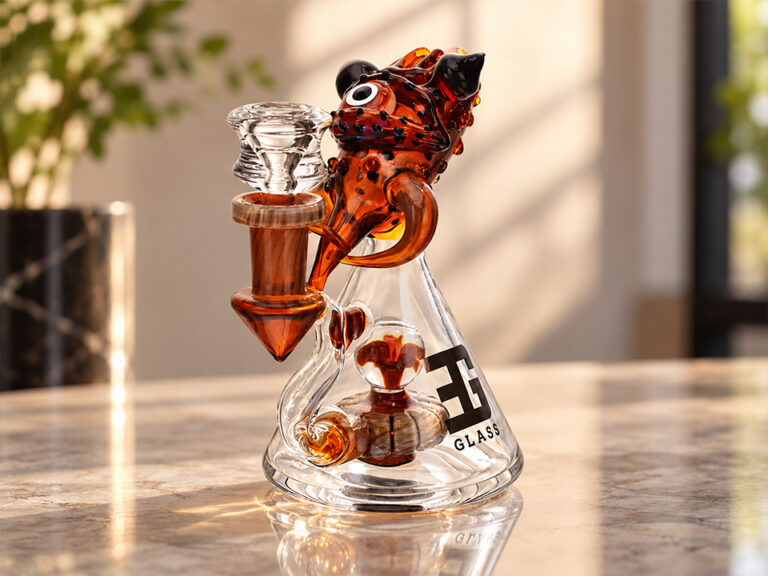
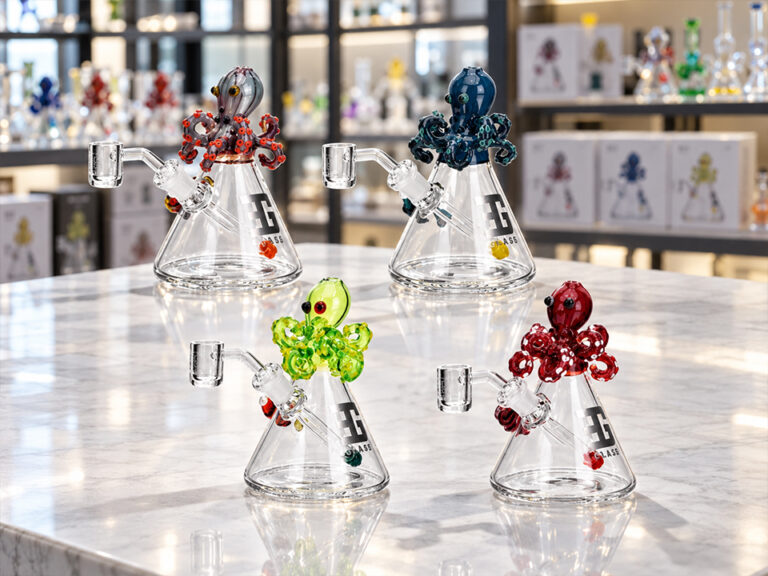
| Compact feature rig | Mini Octopus Head | 5.3 in, 268 g, 14mm joint, four color options | $78.99 | Hand-made detail varies; request photo approval of your colors |
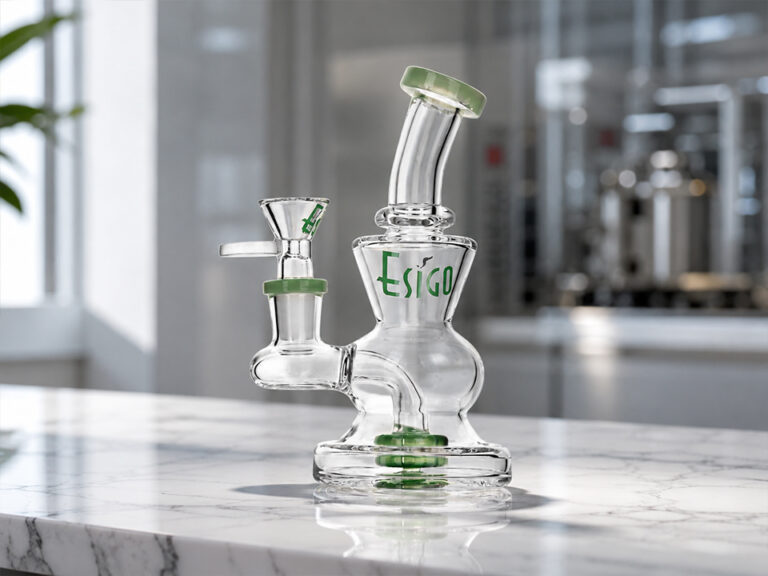
| Mid-size rig with diffusion | ES2237 | 8.5 in, 457 g, 14mm joint, clear | $50.99 | Dimensions vs. the page’s own description; perc style consistency |
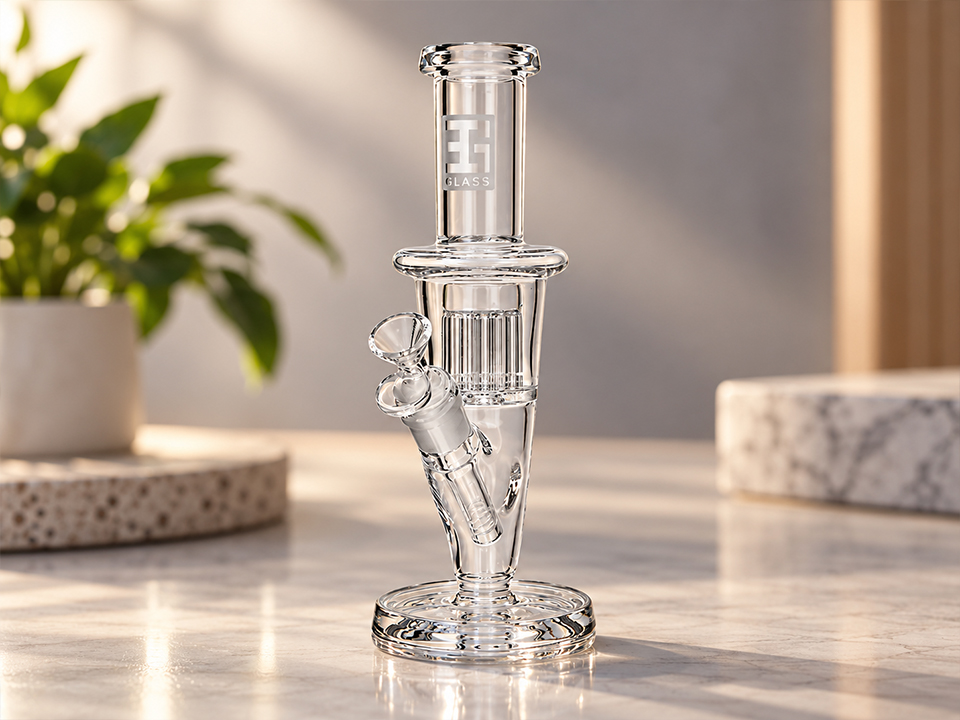
| Tubo reto | ES2260 (12 in) | 12 in, 928 g, 18mm downstem / 14mm bowl, clear | $50.99 | Wall thickness not listed; ask for it |
| Small beaker | EG-76 | 7.5 in, 300 g, four color options | $57.99 | Joint size not in the spec table; fumed finish varies piece to piece |
| Large beaker platform | EG-06 to EG-09 | 14 in, 7mm, 990 g, 18mm downstem / 14mm bowl, five colors each | $79.99 | Color mix per carton; how designs are packed and protected |
| Accessory | EGB45 bowl/slide | 14mm joint, five color options | $40.99 | Joint gender and fit against your specific pieces |
Two observations matter for buying decisions.
Price does not track size. The 5.3-inch octopus-head rig is listed at $78.99, while the 12-inch straight tube and the 8.5-inch rig are each listed at $50.99. Price per inch or per gram is a poor shortcut. Design detail, color work, and construction type appear to drive price more than size. This means you cannot rank your shelf by size and assume the order reflects margin, so check each SKU’s actual cost and sell-through.
Variants multiply faster than designs. Four 14-inch beaker models and five colors each produce 20 design-and-color combinations from what looks like one platform. Per the listed specs, all four share the same height, 7mm thickness, weight, and joint sizes, so they differ mainly in decoration. For a shop this is useful. You can hold one beaker format for accessory compatibility, then test designs one at a time before committing depth.
Use Real Product Examples to Test the Assortment
Walk the wall and ask what each slot is for. A shop that wants a small entry rig can look at a 4.1-inch double-horned one-piece mini rig as one reference for the format. For a slightly larger, more decorative compact piece, the 5.3-inch mini octopus-head rig shows how a feature piece differs on weight and listed joint size. A bent-neck tree perc rig shows a diffused mid-size format.
On the water-pipe side, the 7.5-inch fumed beaker pipe is a smaller beaker format, and a 12-inch straight tube with a circle splash represents the straight-tube category. Buyers who want to compare large beaker designs on one platform can review the diamond-pattern 14-inch beaker bong, o maze-design 14-inch beaker, o EG-07 skull flower beakere o EG-06 skull flower beaker. Comparing them side by side shows how much of the range is decoration.
Treat Joint Size as an Assortment Rule
Joint size decides which accessories sell with which pieces. In the listings above, the large beakers and the straight tube list an 18mm downstem with a 14mm bowl, and the octopus and ES2237 rigs list 14mm joints. A temple-handle bong bowl and slide lists a 14mm joint, so it fits the 14mm group, but the listing does not state joint gender. Confirm it before you stock the accessory next to a specific piece.
A simple rule keeps the range clean. Standardize on as few joint sizes as your customers allow, label them on the shelf tag, and stock replacement bowls and slides in proportion to the pieces they fit. Accessories are also a good place to put safety stock, because they are small, cheap to hold, and frequently needed.
Set Reorder Rules for the Next Quarter
Replace “reorder when the shelf looks thin” with numbers:
- Reorder point = (average daily units sold × supplier lead time in days) + safety stock.
- Safety stock should be higher for A items with long or variable lead times and close to zero for C items.
- Breakage allowance: add a percentage to glass orders based on your own damage history, not a generic figure. If you have no history, start tracking it now and review it at day 90.
- Test-then-deepen: buy a small quantity of any new design or color, review sell-through after a set window, then increase depth only for proven sellers.
- Fixed review cadence: review A items weekly or biweekly, B items monthly, and C items quarterly.
An illustrative example, not a real case: a shop reviews 12 beaker SKUs and finds that three colors account for most unit sales while the others have more than 20 weeks of supply. The reset reduces the slow colors to one unit each, raises safety stock on the three leaders, and moves a small test order to a new design. Cash is released, and fewer stockouts appear on the items customers ask for.
What Should You Ask a Supplier Before Placing a Reset Order?
Reset orders go wrong when buyers lock in depth before they understand terms. Collect these answers in writing before placing the first order:
- MOQ: Is it per order, per SKU, per design, or per color? Can you mix colors and models within one order?
- Lead time and repeatability: How long does a reorder take, and is the same design and color reliably available again? Hand-finished items such as fumed or color-worked glass can vary between batches.
- Spec completeness: Ask for height, wall thickness, weight, joint size and gender, and bowl or downstem inclusions on every SKU. Several listings above omit at least one of these fields.
- Packaging and breakage: Ask how glass is packed, what inspection is done before shipment, and what the claim window and process are for damage.
- Photos or video before shipping for colors and finishes that vary piece to piece.
- Landed cost: Get unit price, freight, and any handling charges in one quote. The supplier’s website shows free U.S. shipping on orders over $50, but that is a retail shipping message, so confirm business-order terms separately.
- Compliance and documentation: Ask what paperwork the supplier can provide, and match it against your local requirements.
If you are comparing suppliers, put the answers in one sheet and compare total landed cost per sellable unit, not unit price. A cheaper quote with a weak breakage process or an incomplete spec can cost more once damaged or unfit pieces are counted.
How Do You Know the 90-Day Reset Worked?
Measure at day 90 against the baseline from day 1:
- Weeks of supply on A items: has it moved into your target range, with fewer stockouts?
- Share of inventory dollars in aged stock: has it fallen?
- GMROI, overall and by category.
- Breakage and return rate on glass.
- Cash released from clearance, and how much of it went into A and B items.
Then repeat a lighter version quarterly. A reset is a diagnostic. The reorder rules are what stop the problem from returning.
Perguntas mais frequentes
How long does a smoke shop inventory reset take?
Plan for about 90 days. Use roughly 30 days to count and classify, 30 to clear aged stock, and 30 to rebuild the assortment and set reorder rules. A small shop with clean POS data can move faster.
What is dead stock in a smoke shop?
Dead stock is inventory with no meaningful sales over a period longer than your normal selling cycle. Many shops start with 90 days without a sale. Seasonal or tourist-driven stores should lengthen that window before labelling items dead.
Should I discount all slow-moving glass at once?
No. Find the cause first. Items in poor locations may sell after a move, weak colors may need only a small markdown, and bundled accessories can clear stock without lowering the headline price. Use staged markdowns with an end date.
How do I decide how many colors of one design to carry?
Rank colors by unit sales and margin dollars, then keep the top two or three. Buy others in single units or test quantities. A design with five color options is five stock decisions, so each color needs its own sell-through record.
Why does joint size matter for inventory planning?
Joint size determines which bowls, slides, and downstems fit each piece. If your range mixes 14mm and 18mm joints, accessories can strand as dead stock. Standardize where possible, label sizes clearly, and confirm joint gender with the supplier.
How should I calculate a reorder point for glass products?
Multiply average daily unit sales by supplier lead time in days, then add safety stock. Increase safety stock for top-selling items with long lead times, and add a breakage allowance based on your own damage history.
What should I verify with a supplier before a large restock?
Confirm MOQ by SKU or order, lead time, color and design repeatability, full specifications including joint size and thickness, packaging and breakage handling, and total landed cost. Compare suppliers on cost per sellable unit, not unit price.