Free shipping in the U.S. for orders over $50

How to Source Reliable Wholesale Smoking Accessories Faster
But I’ve watched buyers shave three days off sourcing, feel clever about it, then lose three weeks cleaning up breakage, redoing carton specs, arguing over crooked joints, and trying to figure out why the “in-stock” borosilicate piece they approved in photos suddenly arrives with soft welds, sloppy maria work, and packaging that looks like it was designed by somebody who hates glass. Worth it?
Table of Contents
Most suppliers aren’t slow — they’re slippery
Here’s the ugly truth: a lot of “fast” wholesale smoke shop supplies sourcing is just bad sourcing with a timer on it. A broker forwards a recycled catalog. A factory says yes before it checks furnace load. Somebody promises “same day quote” and then buries the real MOQ, the actual color limitation, and the breakage allowance in message seven. I’ve seen that movie.
So I don’t open with price. Never do. From my experience, the first useful questions are boring as hell — lead time by SKU, tube thickness, joint size, defect tolerance, inner-pack method, master carton count, remake policy. Not glamorous. Very profitable.
And freight can wreck the whole pretty story anyway. Reuters reported in June 2024 that container freight prices from Asia to the U.S. and Europe had tripled since early 2024, which is exactly when weak suppliers start getting creative with promises they can’t keep because they’re juggling capacity, delays, and rate shocks on the fly.

What “reliable” actually means in wholesale smoking accessories
Reliable isn’t a mood. It’s repeatability.
A reliable wholesale head shop supplies partner can quote the same 7-inch piece in borosilicate 3.3, confirm 14 mm versus 18 mm fit without stalling, tell you whether the color pull is batch-stable, and explain what happens if breakage lands above 2% after delivery — without vanishing into “dear friend, no worries.” That’s the bar. Mine, anyway.
And I frankly believe buyers overrate factory size and underrate merch sense. Stores don’t buy “glass.” They buy velocity. They buy shelf pull. They buy weird little visual hooks that make a customer point at a piece before the budtender says a word. That’s why a supplier showing something like a mushroom hand pipe design gets my attention faster than a page full of dead-clear spoons.
Same with attachments. A catalog that includes a detailed part like an eyeball claw bong bowl style tells me more than people think — color application, joint consistency, decorative control, whether the shop floor can actually repeat a “fun” SKU without turning every third unit into a claim. Little things. Expensive things.
The six checks I run before I trust anybody
I want evidence first. Pleasantries later.
If a supplier can’t give me ugly phone video from the line — not polished promo junk, real shop-floor footage with harsh light on the mouthpiece, the weld, the canework, the bowl seat, the carton insert — I assume I’m not talking to the actual operation. Maybe that sounds harsh. Good.
| Check | What I ask for | What a good answer looks like | Red flag |
|---|---|---|---|
| Material | Borosilicate 3.3 or soda-lime? Any lab/XRF heavy-metal screening for decorated parts? | Specific material, finish notes, and test language | “High quality glass” with no spec |
| MOQ | MOQ by SKU, colorway, and carton | Clear split-pack or mixed-SKU policy | One vague MOQ for everything |
| Lead time | Sampling days, production days, packing days | Separate timelines for sample and mass run | “7-15 days” for all orders |
| Defect policy | Breakage rate, cosmetic tolerance, replacement terms | Numeric threshold, photo protocol, credit window | “We always solve problems” |
| Packaging | Inner box, foam, divider, drop resistance | Carton dimensions and master-carton count | Packaging “can be customized later” |
| Compliance | HS code, country of origin, invoice accuracy, consignee support | Clean paperwork and consistent descriptions | Under-valuing or mislabeling hints |
That table looks dry. Good. Dry is where the money is.
Fast sourcing comes from tighter SKU discipline
Yet this is where buyers burn hours they never get back: they ask five suppliers to quote 300 random SKUs, half of them novelty dead stock, then act surprised when the reply is messy, late, and impossible to compare apples-to-apples. Don’t do that. Use a controlled basket.
I work in three lanes. First, openers — reliable volume pieces that don’t need a TED Talk to sell. Second, eye-catchers — higher-margin shelf bait. Third, companions — bowls, rigs, and add-ons that quietly lift basket size. That’s it. Cleaner. Faster.
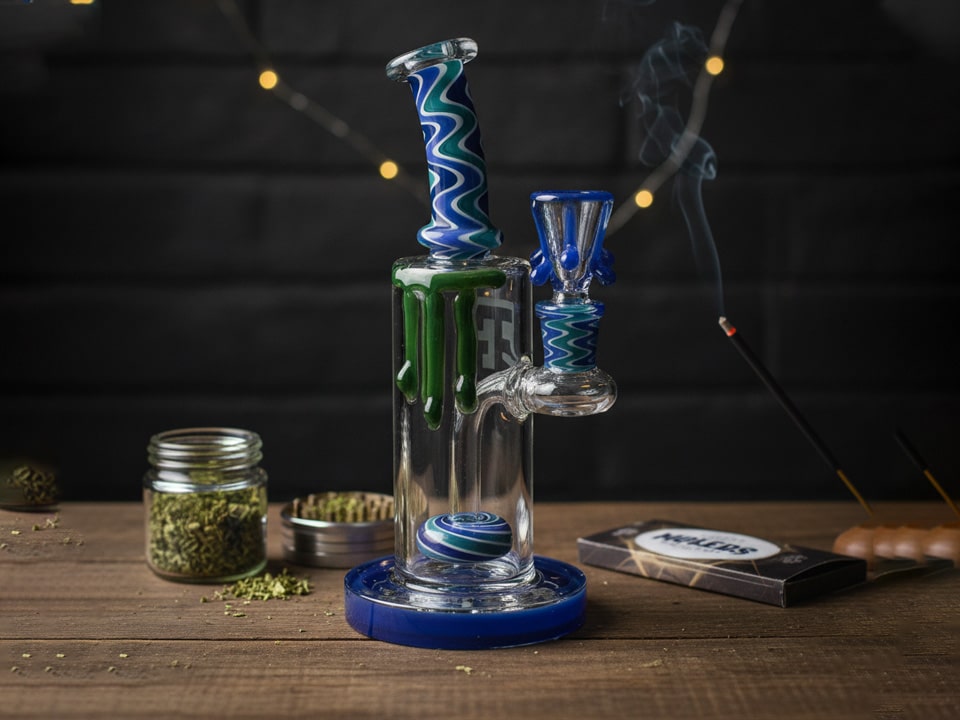
For openers, I’d test something like this honey bee straight tube bong because it sits in that sweet spot between familiar and not totally generic. For visual heat, the yellow-red lollipop tube is a decent stress test — if the supplier can’t keep color clarity and form balance on a piece like that, I learn fast. And for concentrate-heavy assortments, a solid-color cactus rig tells me almost immediately whether the shop can hold joint accuracy and body balance or if I’m about to buy a carton of wobble.
That’s the trick. Not more SKUs. Better controls.
Cheap suppliers usually expose themselves in compliance
But let’s stop pretending compliance is “paperwork.” It’s margin defense.
In October 2024, the FDA and CBP announced the seizure of roughly three million unauthorized e-cigarette units with an estimated retail value of $76 million, and the agency said many of the products had been misdeclared with inaccurate values to dodge duties and scrutiny. Different category, same lesson: if a supplier plays cute with descriptions, you’re next in line for the headache.
And I still look at forced-labor enforcement, even when somebody tells me “these are just accessories.” Why? Because customs doesn’t care about your excuse after the fact. CBP’s UFLPA dashboard exists for a reason, and any supplier that gets twitchy when origin, inputs, or production chain questions come up is telling on itself.
Counterfeits are another trap. CBP’s FY 2024 IPR reporting says the total number of goods seized for intellectual-property violations has more than doubled since FY 2020, which is why I bail the second a factory gets overeager about protected logos, character work, or “inspired” designs that feel one lawyer away from becoming your problem.
And safety enforcement? Not sleepy. The CPSC reported 333 recalls covering 153 million consumer product units in FY 2024, up from 313 recalls and 97 million units in FY 2023. So when a supplier shrugs off packaging specs, labeling, or material details, I hear one thing: future claims.
My 72-hour shortlist method
I don’t overcomplicate it. Day one, I send the same 10 to 12 SKUs to every supplier — same size calls, same wall thickness, same color notes, same imprint position, same carton cap, same payment assumption, same Incoterm. Day two, I score the reply quality. Day three, I cut ruthlessly.
Friendly reps lose. Clean operators win.
Here’s what I score:
| Supplier trait | Weight | What I want |
|---|---|---|
| Quote accuracy | 25% | No missing fields, no evasive ranges |
| Lead-time credibility | 20% | Sample and bulk timelines separated |
| QC transparency | 20% | Video proof, defect terms, remake process |
| Packaging competence | 15% | Breakage prevention detailed by carton |
| Compliance maturity | 10% | Clean invoice language, origin clarity |
| Merchandising fit | 10% | Styles that actually move in-store |
Everybody asks for the best wholesale smoking accessories suppliers. I think that question is half wrong. The real question is uglier: who can repeat a profitable outcome for 90 days without blowing up your inbox, your landed margin, or your returns bin?
That’s the supplier I keep.

FAQs
What makes a wholesale smoking accessories supplier reliable?
A reliable wholesale smoking accessories supplier is a vendor that can repeatedly ship the same product specs, packaging quality, documentation accuracy, and lead-time performance across multiple orders while clearly stating defect tolerance, replacement terms, and breakage policy before money changes hands. After that, my personal filter is simple: if they can’t prove consistency with line video, carton math, and written QC terms, I don’t trust the quote.
How fast should a supplier quote and sample?
A fast supplier in this category is one that can deliver a complete, usable quote within 24 hours and a credible sample timeline within roughly 3 to 7 days for standard pieces, while separating sample lead time from production lead time and not hiding MOQ details. It sounds basic, but most “fast” replies aren’t actually usable. They’re teaser replies. Big difference.
What documents should I request before placing a first order?
The minimum document stack for wholesale smoke shop supplies is a formal quotation, pro forma invoice, packing spec, replacement policy, product specification sheet, and accurate country-of-origin and invoice-description language that matches what will actually ship through customs. I also want carton dimensions, unit weight, master-carton count, and photo-claim rules. That’s not overkill — that’s how you avoid paying tuition to the supply chain.
Are cheap bulk smoking accessories worth buying?
Cheap bulk smoking accessories are only worth buying when the lower unit cost still holds up after freight, breakage, slower sell-through, customer complaints, and claim friction are all added back into the real landed margin calculation for the SKU. From my experience, buyers get hypnotized by the piece price. Then the carton lands. Then reality lands harder.
How many suppliers should I keep active?
A sane sourcing setup usually means one primary supplier, one backup that is already quote-qualified, and one trend-driven niche source for novelty or seasonal pieces, so you preserve leverage and continuity without creating total communication sludge. More than that can look sophisticated — until it turns into chaos. I’d rather have three accountable vendors than eight “options” I can’t really audit.
If you want to source faster, stop buying the fantasy that speed comes from the lowest quote or the biggest catalog. It doesn’t. It comes from tighter SKU control, meaner vetting, cleaner carton math, and suppliers who stay precise when the questions get annoying. That’s the whole play.