Free shipping in the U.S. for orders over $50

Executive Playbook for Growing a Modern Glass Category
Most stores drift. I’ve sat in enough smoke-shop back rooms and looked at enough messy category exports to know what usually happened: somebody kept buying whatever looked fresh at a trade show, somebody else kept slapping “premium” into the copy, and somehow the team convinced itself that a bigger catalog meant a smarter business. It doesn’t. Usually.
Table of Contents
Most glass stores are over-assorted and under-merchandised
But let’s not kid ourselves. The average glass category is a junk drawer with decent photography.
I frankly believe that’s why so many shops stall out. Not because the market disappeared. Not because shoppers stopped caring. Because the assortment is all elbows—too many near-duplicate tubes, too many rigs cannibalizing each other, no clean step-up logic, no obvious good-better-best ladder, no real story around materials, function, or who the piece is actually for. That’s not merchandising. That’s hoping.
And here’s the ugly truth: if you’re selling borosilicate, then say it like you mean it. Don’t bury it in a vague line about “high quality.” SCHOTT’s technical glass material explains why borosilicate 3.3 gets taken seriously in the first place: typical content at 12–13% B2O3, more than 80% SiO2, and low thermal expansion at 3.3×10⁻⁶/K. That’s not fluff copy. That’s actual material logic. schott.com
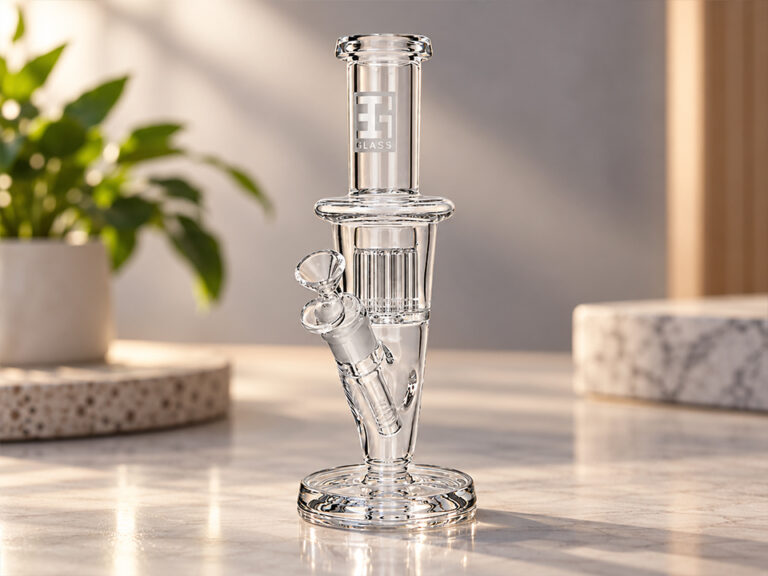
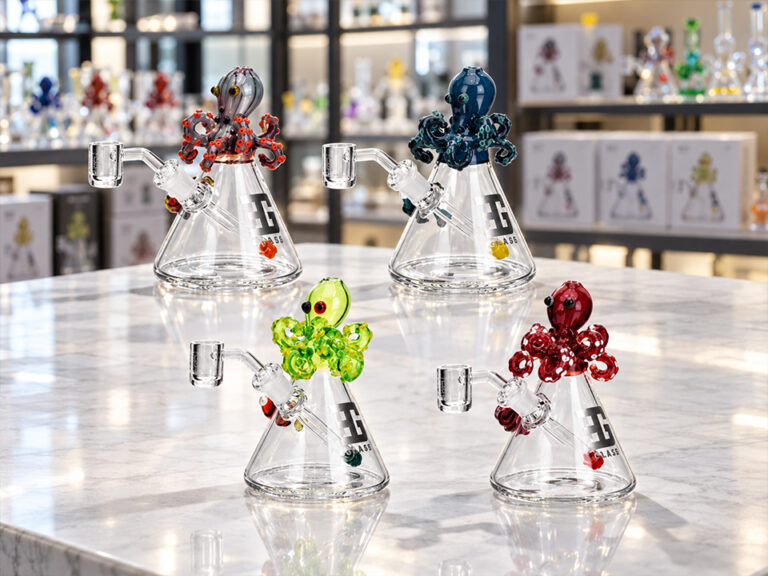
So if I were cleaning house, I wouldn’t start with a giant buy. I’d start with a cleaner assortment spine built around an 18-inch borosilicate straight tube bong with inline perc, an EG-64 octopus head borosilicate dab rig, and a 9-inch bent neck super splash perc rig. Right there, the shopper can feel the laneing: classic volume piece, statement rig, compact functional rig. Cleaner shelf story. Cleaner site story.

The demand pool is larger, and more regulated, than lazy operators admit
Yet I still hear the same old dodge: “Yeah, but the market’s niche.” No. That’s stale dealer talk.
As of February 2024, the CDC said 24 states, the District of Columbia, and two territories allowed non-medical adult cannabis use, while 47 states, D.C., and three territories allowed medical use, which means the legal, adjacent-accessory opportunity is not some underground side pocket anymore but a broad, fragmented, state-shaped retail environment where category quality matters more than hype. That’s the real setup.
And then sentiment shifted again. Reuters reported in April 2024 that cannabis stocks jumped after the U.S. Department of Justice moved to reclassify marijuana as a less dangerous drug, and analysts estimated Schedule III could create cash benefits of more than $150 million for operators by easing 280E tax pain. That doesn’t magically fix retail. But it changes the mood, the math, and the willingness to invest.
So, yes, I think plenty of merchants are still building for yesterday’s market. Why are they acting scared when the map already changed?
Online keeps taking share, which means weak PDPs are a tax on growth
Here’s where it gets painful. The traffic excuse is usually a cop-out.
Because online retail didn’t slow down just to make mediocre glass stores feel better. The Census Bureau says e-commerce represented 16.1% of total U.S. retail sales in 2024, and its Q4 2024 data showed not-adjusted e-commerce sales up 9.3% year over year while total retail sales rose 4.5%, which is another way of saying digital keeps eating share while weak product pages keep leaking intent.
From my experience, the glass category gets hit harder by bad PDPs than a lot of outsiders realize. A shopper lands on a page and can’t quickly tell height, neck style, perc style, use case, material grade, or why one piece costs $20 more than the next one. Gone. That’s the bounce. Not mysterious. Not algorithmic voodoo. Just bad retail hygiene.
And honestly, I’m tired of seeing operators pour money into paid clicks while their collection pages still read like supplier spreadsheets with prettier thumbnails. That’s not a growth plan. That’s burn.

Build the category like a portfolio, not a flea market
So here’s how I’d frame it. Every SKU needs a job—or it’s dead weight.
Not a poetic job description, either. A commercial job. Opening-price converter. Core revenue driver. Halo piece. Search-capture page. Giftable impulse item. If a product can’t earn one of those slots, I don’t care how “cool” it looked in the line sheet. It’s clutter.
I’d use a 12-inch clear beaker bong as the cleaner, easier-entry play. I’d keep the 18-inch borosilicate straight tube bong with inline perc in the core because that’s the kind of shape shoppers already understand fast. Then I’d let the 9-inch straight-neck double UFO perc rig and the EG-64 octopus head borosilicate dab rig do the halo work—the eye-catchers, the AOV lifters, the “this store actually has taste” pieces. And the 9-inch bent neck super splash perc rig sits in a nice little pocket between compact practicality and functional appeal.
That mix works. Usually.
| Category lever | What average stores do | What serious operators do | KPI that matters |
|---|---|---|---|
| Entry tier | List cheap glass and hope volume shows up | Use one or two clean hero SKUs with clear specs and strong collection placement | Conversion rate |
| Core tier | Overload with lookalikes | Build around proven shapes, sizes, and borosilicate-led value stories | Revenue per session |
| Halo tier | Treat design pieces as ornaments | Use premium rigs and distinctive forms to raise AOV and brand trust | Average order value |
| Content tier | Write thin copy | Build spec-heavy PDPs, comparison copy, FAQs, and internal-link paths | Organic landing-page revenue |
| Inventory tier | Reorder by gut | Replenish winners, cut dead duplicates, and protect depth in core shapes | Stock turn and gross margin |

Your copy is probably too soft for a skeptical buyer
Three words here: specs beat adjectives.
And that matters because glass buyers—especially repeat buyers and anyone who’s spent time around functioning headshops, wholesale lists, and real conversion data—can smell fake premium language instantly, so when a PDP keeps babbling about craftsmanship, artistry, and “elevated experience” but never really explains form factor, perc utility, neck angle, balance, footprint, or why borosilicate matters, the copy starts sounding like it was written by somebody who has never sold a tube in their life. Brutal, yes.
But true.
A line like “premium quality” tells me nothing. A line like “compact 9-inch rig, bent neck, splash-control profile, borosilicate construction, better fit for smaller setups and quicker shopper decision-making” actually moves the puck. It’s not romantic. It converts.
Margin gets punished when the underlying market gets messy
However, this is where lazy category strategy gets smoked. Fast.
Reuters reported in August 2024 that California wholesale flower prices had fallen from above $2,000 per pound during the pandemic to around $1,200, that state cannabis sales slipped to $5.3 billion in 2023 from nearly $6 billion in 2021, and that active business licenses were down more than 20% year over year in Q1 2024. That is what compression looks like in the wild—real price pressure, real shakeout, real stress.
And when that kind of squeeze rolls downhill, accessory sellers feel it. The operators who live on lazy promos, copycat assortments, and mushy positioning start haircutting price because they have nothing else to defend. The operators who survive already built spread into the mix: better material claims, better tiering, better halo pieces, better merchandising. That’s why I keep saying category management isn’t some consultant phrase. It’s margin defense.
What executives should do in the next 90 days
So what would I actually do? Not theorize—do.
First, cut the zombie SKUs. The ones that sit there looking busy, stealing clicks from better items, making the category feel wider while actually making it weaker. Second, rewrite the top product pages like a merchant, not a brochure writer. Third, rebuild collection pages around shopper intent—beaker, straight tube, compact rig, statement rig, borosilicate-first, entry-price, step-up-value. Not supplier naming logic. Never supplier naming logic.
And I’d get ruthless about internal linking. Not random blog links. Intent links. The kind that move a reader from category education into commercial pages naturally, so the site stops acting like the content team and the merch team have never met.
Because that’s another ugly truth: most stores don’t have a traffic problem. They have a translation problem. The site never translates interest into buying confidence.
FAQs
What is a modern glass category?
A modern glass category is a structured retail system that organizes glass products by buyer intent, material quality, price tier, and product role so shoppers can compare faster, trust the assortment more, and move from browsing to purchase without getting stuck inside a wall of duplicate-looking SKUs. In real life, that means the collection is doing actual selling work. It isn’t just showing inventory. The shopper can feel the ladder, the purpose, and the logic.
How do you grow a glass business without bloating inventory?
The best way to grow a glass business without bloating inventory is to narrow the assortment around winning shapes, clear price steps, and stronger PDPs so more traffic lands on higher-converting, higher-confidence pages instead of getting diluted across a pile of overlapping products that all chase the same exact shopper. I’ve seen merchants mistake width for strength all the time. Usually, it’s weakness in disguise. Depth on winners beats shallow bets on everything.
Why does borosilicate matter in modern glass products?
Borosilicate matters because its composition and low thermal expansion make it a stronger material story for heat resistance, chemical durability, and premium positioning, which helps merchants justify price, reduce flimsy “premium” language, and create cleaner differentiation between serious pieces and commodity-level glass products in the same category. Put simply, it gives you a real claim. Not just marketing perfume. That matters when shoppers are comparing hard and fast.
What metrics define strong glass category management?
Strong glass category management is measured by conversion rate, revenue per session, average order value, contribution margin, stock turn, and the sales share captured by core replenishable SKUs because those metrics reveal whether the assortment is guiding buyers cleanly or just creating noise and discount pressure. I also watch dead-stock drag. And duplicate-SKU clutter. Those two quietly wreck more categories than most teams admit.
If I were running this tomorrow, I wouldn’t rush to add another fifty glass products and call it innovation. I’d tighten the mix, harden the copy, clean the navigation, and make every page earn its place—because that’s how a modern glass category grows when the market gets noisy, margins get twitchy, and shoppers stop rewarding lazy stores.