Free shipping in the U.S. for orders over $50

Fast-Cleaning Bong Designs for High-Use Retail Customers
Customers who use a bong every day notice cleaning effort quickly. A narrow neck, a fixed downstem, or a tangle of internal chambers makes maintenance a chore, and a piece that is hard to keep clean is harder to recommend at the counter. For wholesale buyers, the practical question is which design features reduce cleaning time without making the product look plain on the shelf. Cleaning speed is a design property that can be specified and tested, not only a care instruction. This article covers the geometry, removable parts, glass and decoration choices that affect cleaning speed, how common formats compare, and how to check a sample before you place an order.
What Makes a Bong Fast to Clean?
A fast-cleaning bong has few interior surfaces, wide openings, parts that come apart, and a body the user can see through and hold securely. Each of those traits cuts either the number of places residue can collect or the effort needed to reach them.
Retail guidance points the same way. Thick Ass Glass’s guide to the easiest bong type to clean says basic designs with minimal percolation are easier to clean because they have fewer small openings and crevices, and that one-piece beaker bongs with narrow necks and deep water chambers are harder. That is a retailer’s editorial view, not a test standard, but it is consistent with how the geometry works.
Four variables decide most of the outcome:
- Reach: can a brush, cap, or cleaning liquid get to every wetted surface?
- Disassembly: how many parts separate, and are they standard sizes that stay available?
- Visibility: can the user see when the glass is actually clean?
- Handling: is the piece light and stable enough to shake, rinse, and dry without a drop?
Design Features That Control Cleaning Time
Opening width and internal geometry
Cleaning effort rises with every narrow passage. A straight chamber with a wide neck lets a brush or a hand reach the walls; a tall beaker with a tapered neck puts the buildup beyond reach. When reviewing a design, look at the narrowest point inside the piece, not the outer diameter. Ask the factory for the inner diameter at the neck and at any internal joint, and confirm what the listed dimensions actually measure.
The 14-inch colored glass beaker bong is a good example of why this matters. Its listing shows a flared base, an angled downstem with a removable bowl, and a thickness figure written as “7mm*51mm.” The listing does not define the two numbers, so a buyer should confirm whether they refer to wall thickness and tube diameter before treating either as a cleaning-access specification. A tall water chamber also means more liquid, more weight, and a longer rinse.
Removable parts versus fixed parts
Every part that separates is a part that can be cleaned on its own. A removable bowl is the minimum; a removable downstem is better. Fixed downstems create a long, narrow channel that resin reaches first and that is hardest to brush.
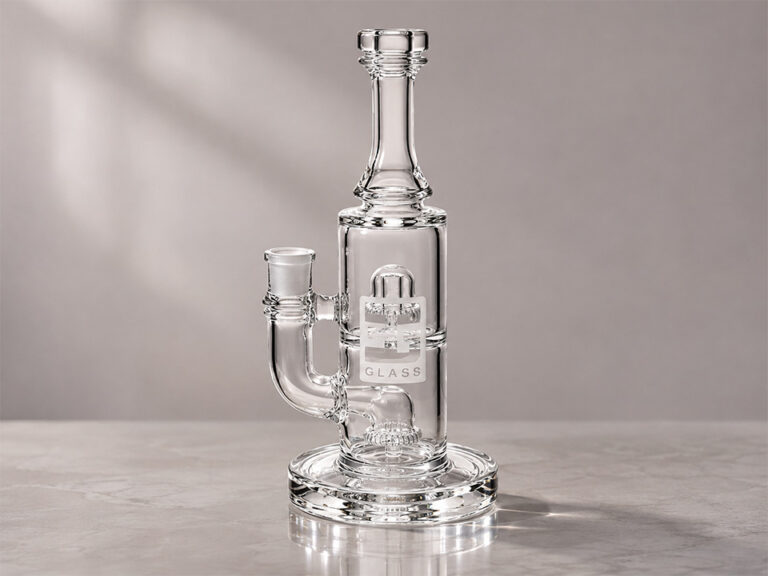
Several of the EG Glass listings describe removable bowls. The clear glass bong with a straight mouthpiece and angled downstem lists a removable bowl and describes easy cleaning, and the color base glass bong states that its removable bowl makes cleaning and packing simple. By contrast, the color-accent bong with a fixed downstem and side bowl joint describes a fixed downstem. That is not a flaw for every customer, but buyers selecting for high-use customers should treat a fixed downstem as a cleaning trade-off and check whether the opening is wide enough to reach.
For any piece, ask whether the bowl and downstem use a standard joint size. Standard joints matter because customers replace bowls and add accessories, and a non-standard size makes the piece harder to keep in use.
Percolators and internal decoration
Percolators add filtration and shelf appeal, but they also add small channels, slits, and chambers that trap residue. The more intricate the diffusion system, the harder the piece is to keep clean, a point the Thick Ass Glass guide above makes directly.
Decorative internals are a separate risk. The color base listing describes a cone-style internal perc with striped or marbled artwork. Artwork inside the chamber looks distinctive, but it can obscure residue and make the interior harder to judge. If you stock this style, ask where the color is applied and whether it sits on surfaces the customer will clean.
Exterior ornament changes the picture. The bee-themed beaker water pipe with honeycomb accents pairs a clear beaker base with decorative glass bees and honeycomb-inspired details. These appear to be exterior ornaments rather than internal structure, though a buyer should confirm that with the factory. Attached glass can create crevices where it joins the body, so inspect those points on a sample.
For percolated designs, an ash catcher offers a practical workaround. The MunchMakers ash catcher guide describes an ash catcher as a separate chamber that intercepts ash and resin before they reach the main bong, so cleaning involves a smaller, simpler piece. Retailers can pair a percolated bong such as the clear glass percolator bong, which has a stacked chamber structure, with a compatible ash catcher. Joint compatibility has to be confirmed first.
Clear bodies and colored accents
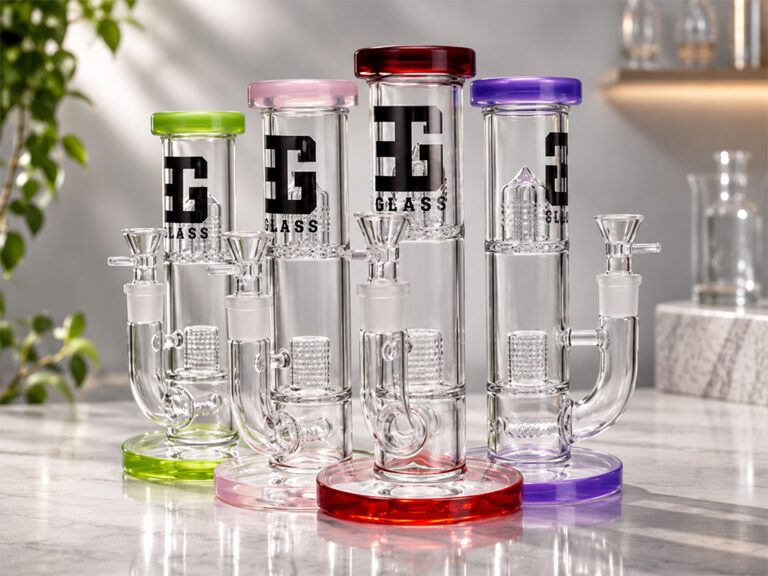
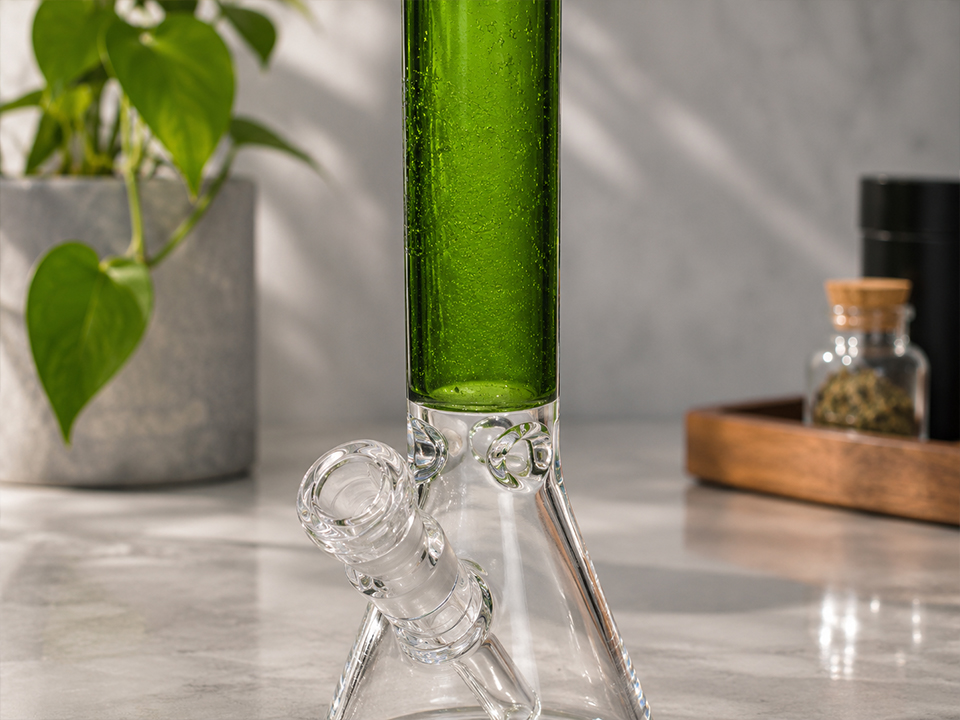
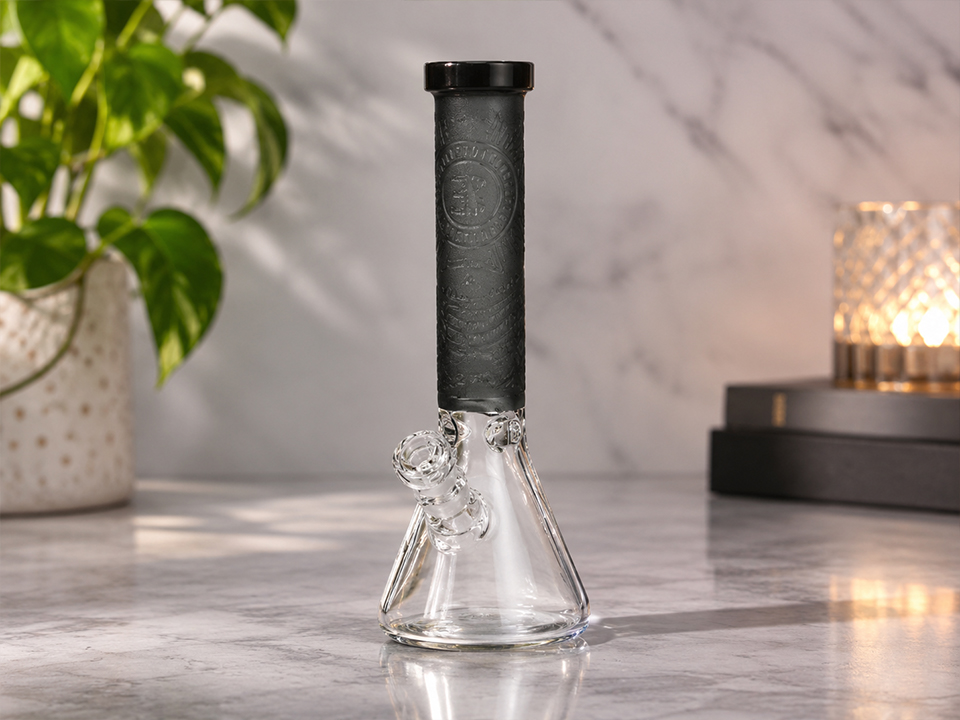
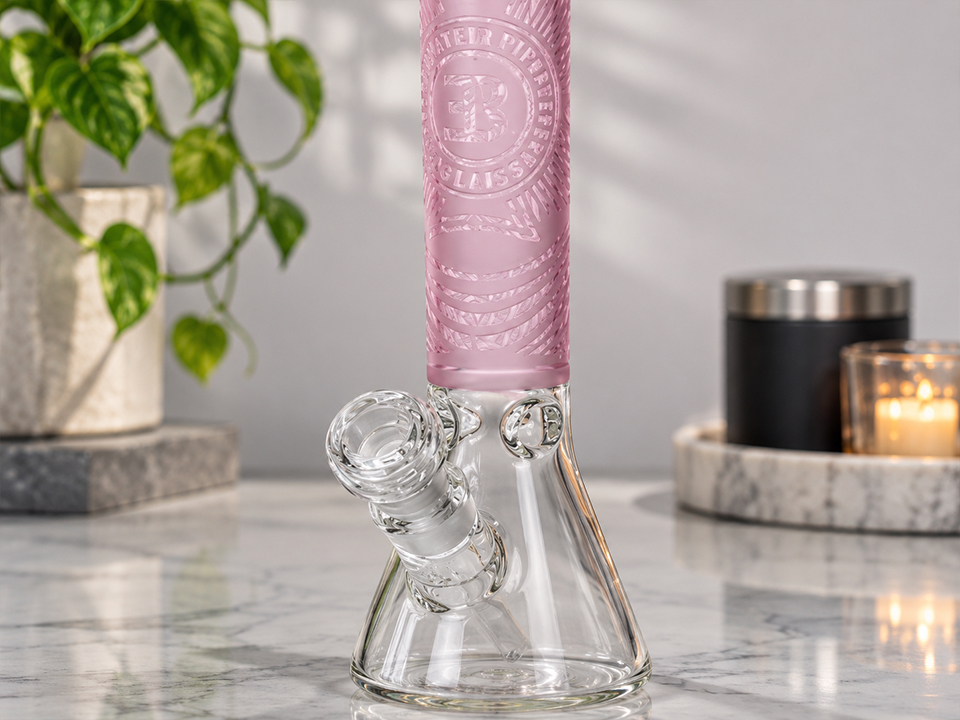
A clear body lets the user see residue, water level, and clean glass. Full-color bodies look strong on a shelf but make it harder to judge cleanliness. Many of the EG Glass designs take a middle path: a clear chamber with color on the base, rim, or mouthpiece. The color-accent bong above describes a clear cylindrical chamber with a wide colored base and matching rim accents, which keeps the interior visible while letting the store merchandise by color.
This approach also helps assortment planning. Color at the rim and base lets you offer five or six colorways without changing the interior geometry that determines cleaning time.
Size, weight, and stability
A salt-and-alcohol shake is harder to do safely with a heavy or tall piece, so compact designs are easier to handle during cleaning. The compact 6.3-inch colorful glass bong lists a 6.3-inch height and 180 g weight with a bent neck, removable bowl, and stable beaker base. A wide base helps the piece stay upright on a counter or in a sink; it does not make a tall, heavy piece easier to shake.
Glass type and wall thickness
Glass type affects thermal and chemical tolerance during cleaning. SCHOTT’s borosilicate glass overview describes borosilicate as having higher chemical durability and thermal resistance than conventional glass types. For a bong, this matters because customers rinse with hot or cold water and use solvents. The bong listings reviewed here do not state a glass type, so confirm it in writing and ask about annealing before assuming any thermal tolerance.
Thicker walls are not automatically better. Thicker glass adds weight, and a heavier piece is harder to handle wet. The right wall thickness balances breakage resistance against handling weight for the intended customer. Ask the supplier to state the wall thickness, the measurement point, and the tolerance.
How Common Retail Formats Compare
The table below is an editorial comparison of general design traits, not the result of laboratory testing. Actual cleaning effort depends on each piece’s geometry.
| Format | Typical cleaning effort | Why | Main trade-off | Best retail fit |
|---|---|---|---|---|
| Hand pipe (dry, single piece) | Low | Few surfaces and no water chamber | Smaller size and a different use experience | Entry price point, impulse and gift displays |
| Straight-tube or simple single-chamber water pipe | Low to moderate | Open, straight geometry that is easy to reach | Less visual complexity on the shelf | Daily users and high-turnover assortments |
| Beaker bong with removable bowl and downstem | Moderate | Large chamber, but wide base and accessible parts | Narrow neck and tall body raise effort | Mid-range core assortment |
| Percolated bong | Moderate to high | Added channels, chambers, and slits trap residue | Premium look comes with harder cleaning | Customers who value filtration styling |
| Percolated bong plus ash catcher | Moderate | Pre-filter catches debris before the main body | Extra part, joint compatibility, extra cost | Upsell for existing percolated lines |
What Do the Listed Product Specs Tell a Buyer?
Product pages are a starting point for an RFQ, not a replacement for sample inspection. The table summarizes what the EG Glass listings above state, and flags what a buyer still needs to ask.
| Listing | Listed height | Listed weight | Listed carton pack | Cleaning-related details stated | Question to ask |
|---|---|---|---|---|---|
| Full-size colorful hand pipe | 4.4 in | 80 g | 200 pcs | Rounded bowl, stem, mouthpiece | Bowl opening size and stem bore |
| Clear glass bong, straight mouthpiece | 6.9 in | 385 g | 50 pcs | Removable bowl, angled downstem, water level visible | Downstem removable? Joint size? |
| Color-accent bong | 6 in | 250 g | 60 pcs | Fixed downstem, side bowl joint, clear chamber | Brush access to downstem |
| Colorful bent-neck bong | 6.3 in | 180 g | 60 pcs | Removable bowl, beaker base | Neck inner diameter |
| Color base bong | 6.3 in | 206 g | 60 pcs | Removable bowl, internal cone perc with artwork | Where artwork sits relative to water path |
| Clear percolator bong | 8.4 in | 472 g | 40 pcs | Stacked chamber, removable bowl | Perc opening sizes, ash catcher fit |
| Bee beaker bong | 10 in | 385 g | 32 pcs | Removable bowl, angled joint, decorative glass bees | Ornament attachment points |
| Colored beaker bong | 14 in | Not listed | 20 pcs | Angled downstem, removable bowl, “7mm*51mm” thickness | Meaning of thickness figure |
Carton counts also affect handling cost. Taller pieces ship fewer to a carton, so freight and breakage exposure per unit rise. The full-size colorful glass hand pipe lists 200 pieces per carton at 80 g, which makes a dry pipe a low-handling, lower-maintenance add-on for stores that want an entry option beside their water pipe range.
Is More Percolation Always Better Value?
Not for every customer. The common assumption is that more chambers and perc stages mean a better, more premium bong. For a shop whose buyers are occasional or gift-oriented, that can be true because the piece is a showcase. For high-use customers who clean frequently, extra internal structure raises the ongoing effort and the chance of a stuck or broken piece during cleaning.
The more defensible rule is to match complexity to cleaning habits. Offer a core range of simple, wide-opening pieces for daily users, a smaller set of percolated or decorated pieces for display-driven buyers, and an ash catcher option where a percolated model sells well. The viewpoint has limits: a simple piece may leave less room for markup, and a customer who wants maximum filtration will accept the cleaning burden. The decision depends on your customer mix, not a universal ranking.
An illustrative scenario: a smoke shop sells to commuters and regular daily users who visit weekly. Its sales staff keep hearing that the percolated bong “is a pain to clean.” Shifting the front-of-store display toward straight, wide-necked pieces with colored rims, and moving the percolated bongs to a feature shelf with a paired ash catcher, changes the conversation at the counter. This is a hypothetical example, not a customer case study.
Which Cleaning Methods Should the Design Support?
Retail cleaning advice commonly involves a solvent and coarse salt, shaken with the openings plugged. The Thick Ass Glass bong cleaning guide and similar retailer guides describe this approach: take the piece apart, shake it with isopropyl alcohol and coarse salt while the openings are plugged, then rinse. Because of that, the design needs openings that can be plugged and parts that can be separated.
Design questions that follow from this method:
- How many openings must the user plug, and do standard caps fit them?
- Can the user shake the piece without the heavy base or bent neck striking the hand?
- Does the geometry let liquid and salt contact every surface, or are there dead zones above a perc?
- Can the piece dry fully, or do narrow passages hold water?
Safety belongs in the supplier’s care instructions. A safety data sheet for isopropyl alcohol hosted by the University of Illinois classifies the solvent as a Category 2 flammable liquid and advises keeping it away from heat, hot surfaces, sparks, and open flames. Retailers who include care cards should not recommend heating the solvent.
What Cost Drivers Affect Fast-Cleaning Designs?
Fast-cleaning features have cost and merchandising effects:
- Glasswork complexity: every extra joint, perc, or attached ornament adds handwork and another point where glass can fail.
- Number of parts: removable downstems add components, packaging, and potential replacement-part inventory.
- Color application: accents on the rim and base are generally simpler than interior artwork. Confirm colors are consistent across batches.
- Carton efficiency: taller pieces reduce pieces per carton.
- Breakage and returns: a design that customers abuse during cleaning can generate returns that offset a lower unit price.
A lower unit price does not always mean a lower total cost. A cheaper piece that generates customer complaints, or that sells slowly, can cost more than a slightly pricier design that cleans easily.
How to Test a Sample for Cleaning Speed
Run a buyer-defined bench test before approving a style. The goal is comparison across candidates, not a certified result.
- Count parts and openings. Record how many pieces separate and how many openings need plugs.
- Check reach. Try a standard cleaning brush in the neck, downstem, and any internal channel.
- Run a cleaning cycle. Use the cleaning method your customers are likely to use, and time it.
- Inspect under light. Look for residue left behind in joints, perc slits, and artwork areas.
- Check drying. Note whether water stays in narrow sections.
- Handle it wet. Note whether the base, grip, and weight feel secure.
Test two or three styles side by side; the comparison is more useful than any single result.
What Should Buyers Specify Before Requesting a Quote?
A precise RFQ reduces back-and-forth and prevents a mismatch at sampling. Include:
- Target customer and use frequency: daily users and gift buyers need different designs.
- Product format and height: state whether you want a dry pipe, straight-tube, beaker, or percolated style.
- Required removable parts: bowl, downstem, and any ash catcher, with joint size.
- Minimum opening size: state inner diameter at the neck and any internal passage.
- Glass type and wall thickness: request written confirmation, measurement point, and tolerance.
- Color placement: specify accent areas such as rim, base, or mouthpiece, and whether interior decoration is acceptable.
- Quantity and assortment: state total order quantity, colorways, and mix.
- Packaging and protection: state pieces per carton, inner packaging, and drop-test expectations.
- Sample requirement: ask for a pre-production sample and a written spec sheet.
- Target market and compliance: rules for selling, labeling, and importing smoking accessories vary by country and region, so confirm with a qualified advisor before ordering.
Also confirm MOQ, lead time, and whether the factory supports customization, because the product pages here do not publish those terms for these listings.
Frequently Asked Questions
What is the easiest type of bong to clean? A simple, single-chamber piece with a wide neck, removable bowl, and no internal percolator is typically easiest to clean. Fewer small openings leave less residue to dissolve and fewer places a brush cannot reach.
Are percolator bongs harder to clean? Generally yes. Percolators add channels and slits where residue collects, so they take longer to clean. An ash catcher placed ahead of the main chamber can reduce how much debris reaches the percolator.
Does a removable downstem make a bong easier to clean? Yes, in most cases. A removable downstem can be cleaned and rinsed separately, and it exposes the joint it was sitting in. Confirm the joint size so replacements and accessories fit.
Should retailers choose clear or colored glass? Clear glass with colored accents is a practical middle option. The clear body shows when the interior is clean, while color on the rim and base gives shelf appeal and makes colorway assortment easy.
Is borosilicate glass better for bongs? Borosilicate offers higher chemical durability and thermal resistance than conventional glass, according to SCHOTT. Still, buyers should confirm the glass type for each product in writing, since listings may not state it.
What should be in an RFQ for easy-to-clean bongs? State format, height, removable parts, joint size, minimum opening width, glass type, wall thickness, color placement, quantity, packaging, sample needs, and target market. Ask for a written spec sheet before sample approval.
How can a buyer test cleaning speed in a sample? Count parts and openings, test brush reach, time a cleaning cycle, inspect joints under light, check drying, and handle the piece wet. Compare two or three candidates under the same procedure.