Free shipping in the U.S. for orders over $50

Annealing of Borosilicate Glass: Points That Retailers Must Verify
Annealing is the controlled reheating and slow cooling that relieves the internal stress left in glass after torch work. For retailers buying borosilicate pipes, water pipes, and nectar collectors, it is one of the few quality factors that cannot be judged by eye. A poorly annealed piece can pass visual inspection, survive packing, and then crack in a warehouse, on a shelf, or the first time it meets hot water. The cost lands on the retailer as returns, replacements, and lost repeat customers. This guide explains what annealing does, which product shapes are most exposed, how stress is checked, and what to verify with a supplier before you place or repeat an order.
What Annealing Does in Borosilicate Glass
When a glassblower forms a piece, it does not cool evenly. Thin walls cool first, while thick bases and fused joints stay hot longer. The two regions contract at different times and lock stress into the glass. Annealing reheats the whole piece until it is uniformly hot enough for that stress to relax, holds it there, then cools it slowly enough that new stress does not build back.
The target temperature is the annealing point, defined as the temperature at which glass viscosity falls to 10^13 poise. Wikipedia’s overview of glass annealing) adds that inadequately annealed glass may crack under relatively small temperature changes or mechanical shock, and may even fail spontaneously. One manufacturer of 3.3 borosilicate laboratory glass publishes an annealing point of 565 °C and states that glass heated above 500 °C may acquire permanent residual stress on cooling. Other borosilicate formulations have different values, so a supplier should name the glass it uses rather than quote a generic figure.
Low thermal expansion and low residual stress are separate properties. Borosilicate’s low expansion helps it tolerate temperature swings, but it does not remove stress frozen in during fabrication. One belongs to the material. The other belongs to the process.
How Does a Proper Annealing Cycle Work?
A proper cycle has three stages:
- Soak: The entire piece, including its thickest section, is held at or near the annealing point until the temperature is uniform.
- Controlled cooling: The piece cools slowly through the range just below the annealing point, where the glass can still relax. The rate must be slow enough to keep the temperature difference between thick and thin sections small.
- Final cooling: Below that range the glass can no longer relax, so cooling can speed up.
There is no universal schedule. Soak time depends on the thickest wall, the kiln load, and how evenly the kiln heats. A supplier who says only “annealed at 560 °C” has described one variable out of four. Ask for the soak temperature, soak duration, cooling rate through the critical range, and how the kiln is loaded.
Loading practice matters too. Putting cold glass into a hot kiln, or opening the door early during cooldown, can add thermal stress instead of removing it. In one practitioner forum thread on borosilicate cracking, an experienced reply says a borosilicate kiln must reach about 550 °C and that 540 °C is dangerously low. That is a single community discussion, not a standard, but it is consistent with the manufacturer figure above and shows why a quoted temperature should be backed by a recorded cycle.
Which Product Shapes Carry the Most Annealing Risk?
Stress risk rises with wall-thickness variation, the number of fused joints, and enclosed internal geometry. Two pieces with the same glass and the same kiln can have very different outcomes because of their shape.
Multi-chamber and percolator designs
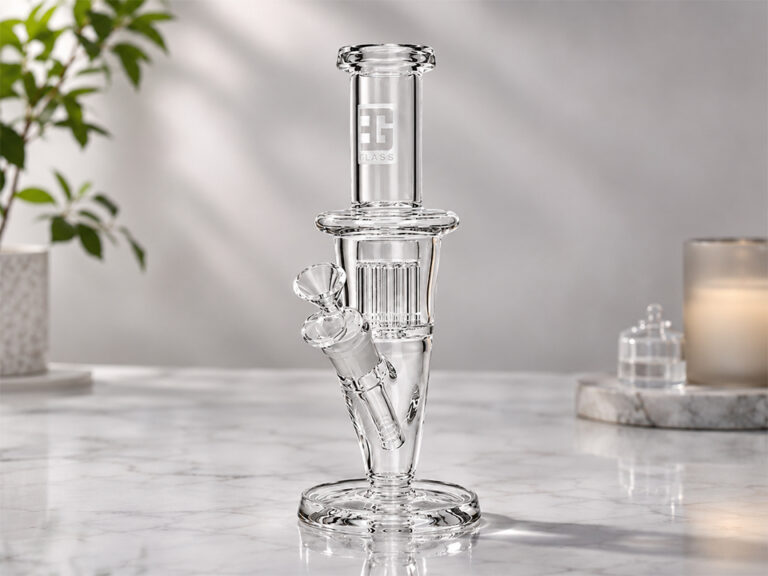
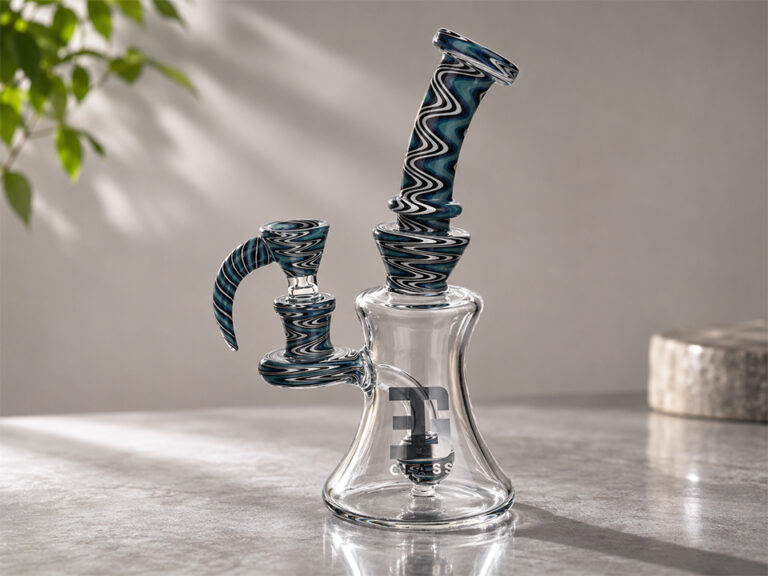
Every welded percolator, chamber, or downstem creates a seam where thin and thick glass meet. A clear glass percolator bong with a stacked chamber, curved neck, and removable bowl is a typical example, listed at 8.4 inches. The full-size recycler dab rig with a cyclone perc adds an internal recycler pathway and weighs 353 g per its product page. More glass mass means thick sections retain heat longer, so the cooling rate matters more. For both shapes, ask where stress was checked: the percolator welds and downstem joint, not just the outer tube.
Large bases and heavy transitions
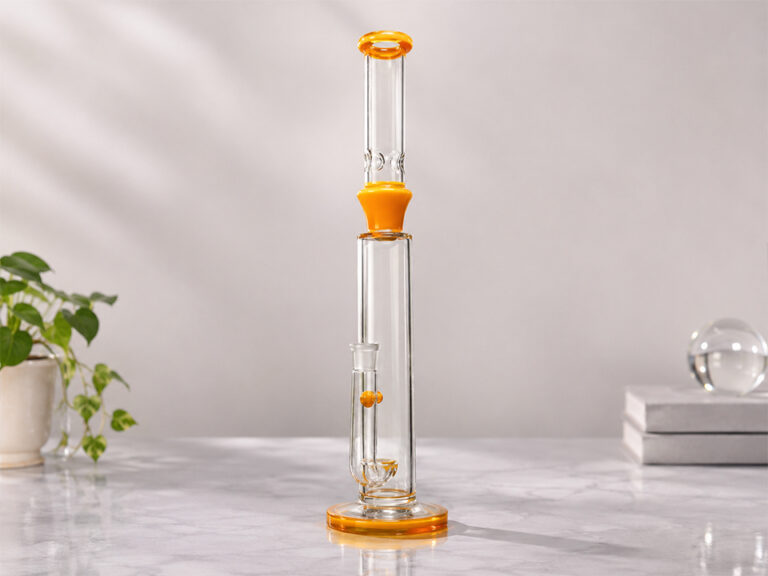
The thickest part of a water pipe is usually its base, and the transition from base to tube is a classic stress zone. A bell-shaped water pipe with a flared round base stands 10.6 inches tall, which makes uniform kiln heating harder than it is for a compact piece. A simpler full-size glass bong with a straight mouthpiece and angled downstem has fewer features, so risk is lower, but the downstem and bowl joints still deserve inspection.
Small pieces and colored glass
Small does not mean exempt. A colored glass spoon hand pipe still has a thick bowl feeding into a thinner neck. When color is involved, the question widens from annealing to material compatibility, covered in the next section.
Nectar collectors with mixed materials
A 510 thread nectar collector kit with ceramic tip combines a glass body with a ceramic tip, a removable 510 thread part, and a silicone jar. Annealing applies only to the glass. The ceramic and silicone parts have their own heat limits and should be specified separately. A portable nectar collector with a pull-and-clean design uses a colored mouthpiece, neck, side grips, inner tube, and base on a clear body, so it has several fused color joints to inspect.
Why Annealing Cannot Fix Incompatible Glass
Annealing relieves stress caused by temperature gradients. It cannot make two glasses with different expansion coefficients shrink in step. If a colored component made from one tube source is fused to a clear body from another, the mismatch creates stress at the bond that can reappear after every heating and cooling cycle, however well the piece is annealed.
This is general glass-science reasoning rather than a finding from a single source, but it points to a practical request. Ask for the expansion coefficient and annealing point of the clear tubing and of each color used, and ask whether color elements come from the same glass system as the body. If a supplier changes color suppliers or tube lots between orders, treat the new lot as a new qualification, not a repeat.
Why “Annealed” on a Spec Sheet Is Not Proof
The common assumption is that a supplier who states the glass is annealed has solved the problem. A more defensible view separates the claim from the evidence. “Annealed” describes a process. Residual stress is an outcome, and it varies by piece, kiln position, and lot.
Two qualifications apply. First, a longer or hotter cycle is not automatically better. A practitioner explanation in a lampworking forum guide to annealing notes that soaking at a higher temperature shortens soak time but risks distortion under the glass’s own weight. Second, annealing quality depends on geometry. A cycle that works for a thin-walled spoon pipe may under-anneal a heavy-based water pipe.
This matters most for thick sections, multi-joint designs, outsourced production, and colored assemblies. For thin, simple pieces from a long-established workshop the risk is lower, but verification costs little compared with a return wave.
How to Verify Annealing: Polariscope Checks and Incoming Inspection
A polariscope is the usual tool. Stress in glass changes how polarized light passes through it, so a stressed region shows colored or banded fringes while well-annealed glass looks nearly uniform. ASTM C148 describes polariscopic test methods for evaluating the quality of annealing, and says they can be used for quality control of glass containers or other products made of similar glass compositions.
That scope has a limit. C148 was written for containers, not hand-formed smoking accessories, so it will not give you a pass/fail rule for a percolator bong. Use it as a reference for method, then agree on an acceptance reference directly with the supplier: approved sample pieces, photographed under polarized light, that define what acceptable stress looks like at each critical zone.
The table below summarizes what to ask for and what should raise concern.
| Verification point | What it tells you | What to request | Warning sign |
|---|---|---|---|
| Glass type and expansion data | Whether body and color components are compatible | Tube supplier datasheet with annealing point and expansion coefficient for clear and each color | No datasheet, or color tubes from unnamed sources |
| Annealing cycle record | Whether soak and cooling were controlled | Soak temperature, duration, cooling rate, and kiln-load description for your lot | Only a single temperature quoted |
| Kiln loading practice | Risk of added thermal shock | How soon after forming pieces enter the kiln, and how they are warmed | Cold pieces loaded into a hot kiln |
| Polariscope inspection | Distribution of residual stress | Photos or video of your product under polarized light | Visual inspection only |
| Critical-zone coverage | Whether stress-prone areas were checked | Inspection of base, neck, percolator welds, downstem, and bowl joints | Only flat tube areas inspected |
| Sampling plan | Lot-to-lot consistency | Agreed sample size per lot, rejection rule, and retest procedure | Testing limited to the pre-production sample |
| Non-glass components | Heat limits of ceramic and silicone parts | Material specification and rated temperature | No data for tips, jars, or seals |
Verification should continue at your end. On receiving a shipment, pull a defined sample from several cartons and check them under polarized light if you have a viewer, concentrating on joints and bases. Record the results by lot. A pattern of fringes at the same joint across several pieces points to a process problem, not bad luck.
Telling Stress Failures from Shipping Damage
Impact breakage and stress failure are different problems with different fixes. Annealing does not protect a piece from a drop. Better packing does, and carton specifications are worth requesting. The linked product pages list, for example, 35 pieces per carton for the 353 g recycler rig and 50 pieces per carton for the 115 g nectar collector kit, which shows how much pack density varies by product.
When a customer returns a cracked piece, record where the crack starts. Cracks that begin at a joint or a thick-to-thin transition with no visible impact point deserve a failure review by the supplier, and delayed breakage with no obvious cause is a stronger signal than a chipped rim. Treat this as a diagnostic habit, not a rule. Send affected lots back for polariscope examination before you reorder.
What Should Retailers Specify Before Requesting a Quote?
A quote that does not specify annealing and inspection can look cheaper because it is cheaper to make. Before you request pricing, prepare:
- Glass type: The borosilicate grade required, plus a datasheet for clear and colored tubing.
- Wall thickness range: Minimum and maximum, particularly for bases and necks, since thickness drives soak time and cooling.
- Annealing requirement: A recorded cycle per production lot, not a verbal confirmation.
- Stress inspection: The method (polariscope), the zones checked, the sample size, and the reference samples that define acceptable.
- Component specifications: Heat ratings for ceramic tips, silicone jars, and any non-glass parts.
- Pre-shipment sample approval: A sample from the actual production lot, not only the prototype.
- Packing: Carton spec, inner partitions, and drop-test expectations.
- Replacement terms: How delayed breakage found within an agreed period is handled.
- Market rules: Product regulations and sales restrictions in your target market, which differ by country and region and should be confirmed locally.
Suppliers who can answer these questions clearly can usually show a controlled process. Suppliers who cannot are not necessarily poor, but you will be absorbing the risk they have not measured.
Frequently Asked Questions
What is annealing of borosilicate glass?
Annealing is a controlled reheating, holding, and slow cooling cycle that relieves internal stress left after glass is formed or joined. Without it, borosilicate pieces can crack later from small temperature changes, handling, or no visible cause.
Does borosilicate glass need annealing if it already has low thermal expansion?
Yes. Low expansion improves resistance to temperature changes, but it does not remove stress locked in during torch work. Fused joints, thick bases, and uneven cooling still create residual stress, so formed borosilicate pieces need annealing.
What temperature is borosilicate glass annealed at?
It depends on the glass formulation. One manufacturer of 3.3 borosilicate publishes an annealing point of 565 °C. Cycle details, including soak time and cooling rate, also depend on wall thickness, so ask the supplier for the actual schedule.
How can a retailer tell if glass is annealed?
Not by eye. A polariscope shows residual stress as colored or banded fringes under polarized light. Request supplier test photos, define acceptable reference samples, and spot-check incoming lots at joints and bases.
Can unannealed or poorly annealed glass crack after shipping?
Yes. Residual stress can lead to cracking during transit, in storage, or on first use, sometimes with no obvious impact. Poor packing causes separate breakage, so check carton protection and annealing records independently.
Can annealing repair incompatible glass or a cracked piece?
No. Annealing relieves temperature-related stress but does not repair cracks or reconcile glasses with different expansion coefficients. Confirm material compatibility, especially for colored components, before production begins.
What should I ask a supplier about annealing before ordering?
Ask which glass is used, the soak temperature and duration, the cooling rate, how pieces are loaded into the kiln, whether polariscope checks are done per lot, and which zones are inspected, such as joints and bases.