Free shipping in the U.S. for orders over $50

COE Compatibility in Colored and Clear Borosilicate Glass
COE compatibility decides whether a finished borosilicate piece stays intact after it leaves the kiln. COE, the coefficient of thermal expansion, describes how much a glass grows when heated and shrinks when cooled. When two glasses fused into one piece shrink at different rates, the joint locks in stress. That stress can crack the piece during cooling, during reheating, or weeks later in a customer’s hands.
For buyers sourcing colored and clear borosilicate pipes, rigs, and tubes, the useful question is not whether a supplier says “borosilicate.” It is whether every clear body, color rod, accent, and joint was chosen to match, and whether the piece was annealed to suit all of them. This article explains what “33 COE” means, why a matching number is necessary but not sufficient, and what to verify before you place an order.
What Does COE Mean in Borosilicate Glass?
COE is the coefficient of linear thermal expansion: how much a glass changes in length for each degree of temperature change. The common laboratory-type borosilicate has a very low value, about 3.3 × 10⁻⁶ K⁻¹, roughly one-third that of ordinary soda-lime glass. Glassblowers shorten this to “33 COE”, the same figure expressed in units of 10⁻⁷. The shorthand commonly appears on borosilicate tubing and color-rod listings.
Three points matter for purchasing:
- “33” is a nominal class, not a guaranteed match. It tells you which family a glass belongs to. It does not tell you how closely a specific colored rod tracks a specific clear tube.
- Borosilicate and soda-lime glass do not mix. Soda-lime expands roughly three times as much, so fusing it to 33 COE borosilicate builds severe stress at the joint.
- Low expansion is not the same as unbreakable. It reduces thermal stress, but a poorly matched or poorly annealed piece can still fail.
Why Does COE Mismatch Cause Cracking?
A COE mismatch causes cracking because two fused glasses contract by different amounts as the piece cools from working temperature. The difference is trapped at the interface as residual stress. The joint can look clean while hot and still be under load once cold.
Timing varies. The piece can crack in the annealer, crack when it is reheated for rework, or fail after shipping. A general reference on glass fusing notes that incompatible glass may shatter during cooling or develop stress at the contact point over time, leading to eventual fractures. That source describes kiln-glass fusing rather than borosilicate pipe production, but the mechanism is the same. ASTM’s stress-analysis method also lists differential thermal expansion between fused components as one cause of residual stress that can affect glass product performance.
For a buyer, delayed failure is the costly version. A piece that passes incoming visual inspection can still crack in a distributor’s warehouse or at retail. Compatibility has to be controlled at the factory, not discovered after delivery.
Are Colored Borosilicate Glasses Less Compatible Than Clear?
Not inherently, but colored glass has more ways to go wrong. Clear 33 COE tubing is a single base composition. Colored glass starts from that base and adds colorants, and colorant chemistry can shift expansion.
A patent filing on colored borosilicate manufacturing describes a common route: grind clear borosilicate, mix in oxide colorants, and remelt. It states that even small oxide additions can cause CTE incompatibility. For that route it describes results that are either weak but compatible color or strong color with compatibility problems. This is an applicant’s account of the prior art, not an industry test result. It does explain why deep colors are where a supplier’s process control shows.
Two conclusions follow, and both are conditional:
- A colored piece from a controlled color system can be as reliable as a clear one. Color manufacturers formulate their rods and tubes to match a 33 COE clear. That separates a compatible color series from generic color glass of unknown expansion.
- A clear piece is not automatically safer. If a clear body from one tube source is joined to a part from another and nobody tested the pair, the assembly carries the same risk as a mixed-color piece.
So the lowest-risk specification is not “clear only.” It is a documented glass system: a known clear base, a known color series, and a record that they were used together.
Risk also scales with how much color is in the piece. A solid-color body, such as the cactus solid colors dab rig series or the solid mushroom hand pipe BSH03, puts colored glass through the full wall thickness. That color glass must then be compatible with every clear part joined to it. Thin color accents on a clear body put less colored mass into the joint, though they still need to match.
Why a Matching COE Number Is Not Enough
Two glasses with the same nominal COE can still be incompatible. The same glass-fusing reference calls it a common misconception that equal coefficients of expansion guarantee compatibility, noting that other factors also matter. In borosilicate work, the most practical of those factors is annealing behavior.
Annealing and strain points can differ between colors
Northstar Glassworks, a colored borosilicate manufacturer, publishes an annealing chart for 33 expansion borosilicate. For clear glass it lists an annealing temperature of 1050°F and a strain temperature of 960°F. It states that compatible COEs between colors and clear are of primary importance. It adds that similar annealing characteristics matter too. If the annealing temperatures differ enough and the cycle is set for the lower-temperature component, the other component may not be fully annealed. That can leave enough residual stress to crack during cooling or later.
The same page names specific colors (Forest Green, Moss, and Blue Spruce) whose annealing and strain temperatures were about 100°F lower than clear. It says they were reformulated to be more annealing-friendly. Because this is one manufacturer’s guidance and formulations change, read it as an illustration of the principle, not a list of colors to avoid. The guidance also says the schedule is based on clear glass and may need adjusting for color. It says metallic-based colors may need a slightly higher annealing temperature.
A supplier running one generic cycle across every color is making an assumption the glass may not support.
Wall thickness and closed forms raise the annealing demand
The Northstar chart scales anneal time with thickness, at one hour per 0.25 inch. It advises treating closed forms as having double the wall thickness. Water pipes, rigs, and sculpted hand pipes are often closed or semi-closed forms with thick junctions, so they sit at the demanding end of that scale. The chart is written for glass artists and is not a production specification. It does show why thick, complex shapes tolerate fewer annealing shortcuts.
This applies to sculpted designs such as the Bonsai Series pot hand pipe, the BSH15 wig wag cactus pot hand pipe, and the Trans Prickly Pear Pot bonsai hand pipe. Wherever a design joins separately formed parts in different colors, each join is a place where expansion and annealing behavior have to agree.
Design features concentrate stress
Geometry affects where stress shows up. Thick-to-thin transitions, raised decoration, and heavy color work create local differences in cooling rate. A buyer reviewing the EGH33 monster eyeballs hand pipe, which features raised eyeball accents, or the Opal Whistle mini dab rig, which is offered in several colors alongside clear, should ask how the accent glass was matched to the body and how the finished part was annealed. The same question applies to the colorful EG-35 wig wag bullet straight tube bong and the etched 11.5-inch dual bullet straight tube bong. Ask which glass was used for the decorative work and how it was matched to the tube.
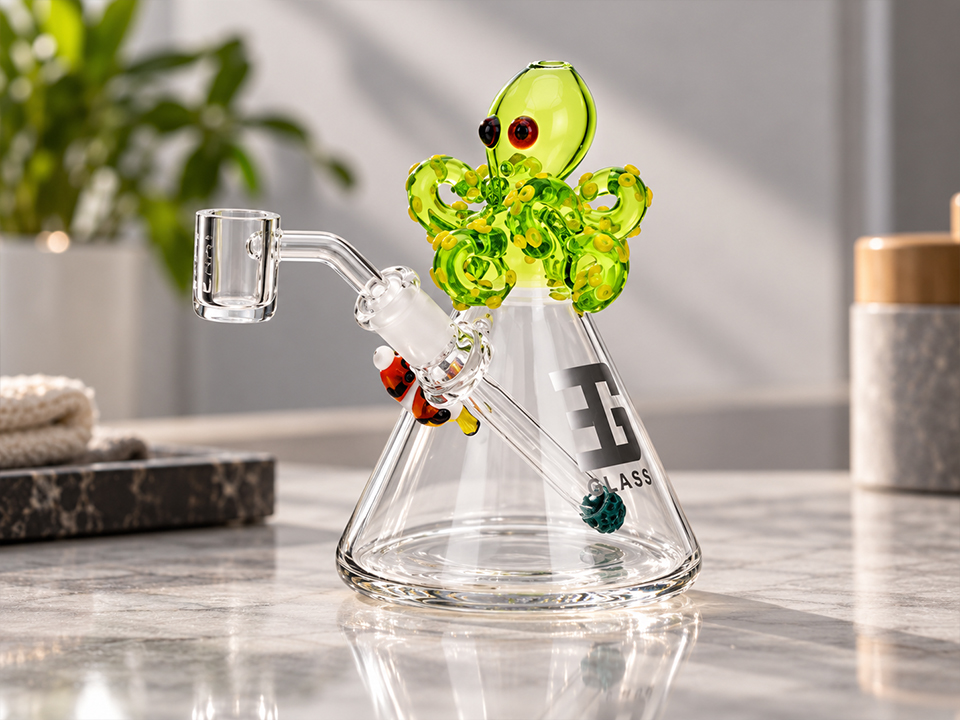
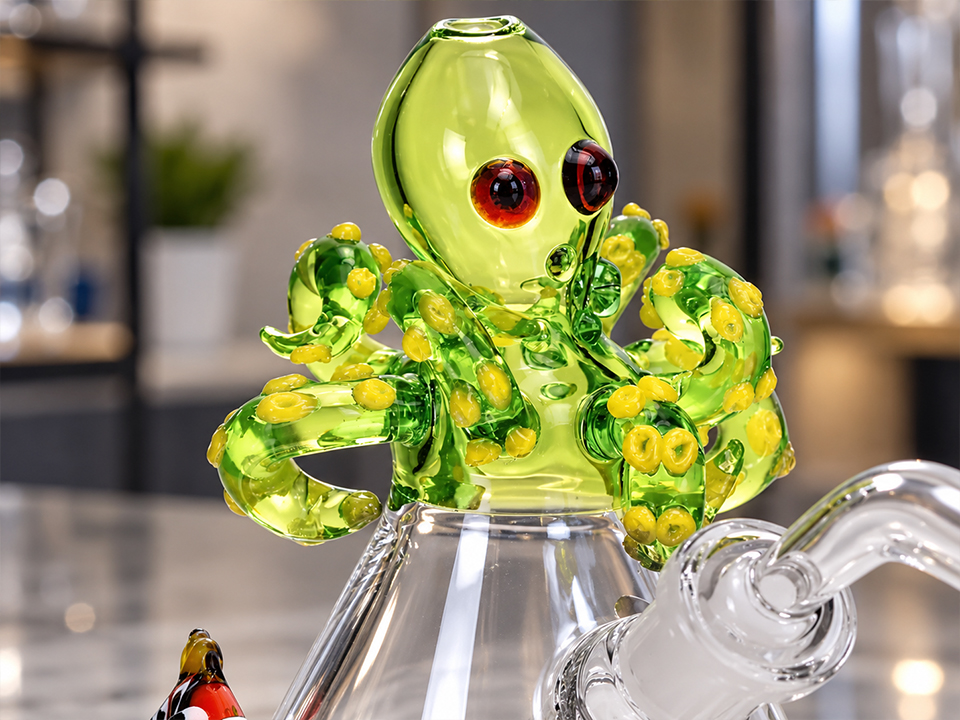
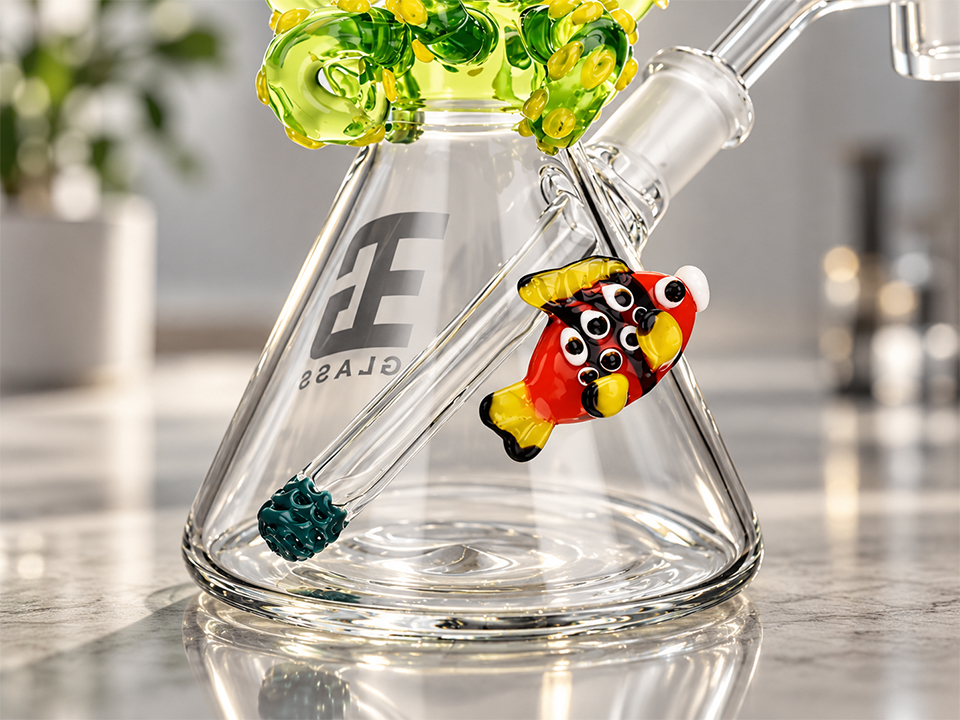
Multi-color designs raise the number of glass types that must agree. If a pattern such as the ES2229 swirl-design water pipe uses more than one color, each color is another pairing to verify. The same goes for the EGH37 ocean-themed hand pipe, the EG-60 reef dab rig with sea life details, and the mini colored glass ring hand pipe. Ask which colors are in the build and whether each came from the same compatible series. These are questions to ask, not findings about how any of these products were made.
Clear designs deserve the same scrutiny. A transparent piece such as the ES2228 transparent dab rig removes color-matching risk from the body. Joints, accessories, and added parts still need to be the same glass family, and the annealing still has to suit the wall thickness.
Where Compatibility Risk Sits: A Comparison
| Construction | Main compatibility risk | What to verify with the supplier |
|---|---|---|
| Clear body, single tube source | Mismatched add-on parts (joints, accessories, bowls) | All parts are 33 COE borosilicate, ideally from the same source |
| Clear body with thin color accents | Accent glass not matched to the clear; local stress around accents | Color series used, whether it is intended for the clear in use, stress check near accents |
| Transparent colored body | Colorant effect on expansion; some colors anneal differently | Color manufacturer and series; cycle used for that color |
| Solid or opaque colored body | Full-wall color glass must match every clear joint; thick sections raise annealing demand | Color compatibility with the clear; cycle matched to the thickest section |
| Multi-color or swirl designs | More glass types in one piece; any one pairing can be the weak link | List of all colors used; whether they come from one compatible series |
| Mixed-source assembly | Unverified pairing, even with identical “33” labels | Written source for each component; pair-specific testing |
The table is qualitative. It shows where risk concentrates, not failure rates, and no row is safe without supplier documentation.
How to Verify COE Compatibility Before You Order
Combine documents, sample inspection, and a clear agreement on what counts as a defect.
- Ask for the glass system in writing. Request the clear base glass, the color series, and confirmation that every component is 33 COE borosilicate. A supplier who cannot name the sources is a risk.
- Ask how pieces are annealed. Find out whether they use kiln or flame annealing, whether schedules differ by color, and which wall thickness the schedule is based on.
- Request stress inspection on samples. A polariscope makes residual stress visible as patterns in the glass. ASTM F218 is the ASTM method for measuring optical retardation and analyzing stress in glass. Full quantitative testing is usually a laboratory task. A practical buyer request is polariscope photographs or an in-house check, with acceptance criteria agreed in advance.
- Agree a sample test regime. Specify any thermal-cycling or handling test and document the pass rule. Don’t rely on visual inspection alone, because stress is generally invisible without polarized light.
- Control repeat orders. A color or base-glass substitution between batches can change the compatibility profile. Ask the supplier to notify you before changing either.
- Separate stress failures from transit damage. Keep retained samples and record where cracks start. Cracks starting at joints or accents often point to stress. Cracks at impact points often point to packing.
What to Include in an RFQ for Colored Borosilicate Glass
| RFQ field | Why it matters |
|---|---|
| Glass type and COE class (e.g., 33 COE borosilicate) | Establishes the base material and excludes soft glass |
| Clear tube source and color series | Compatibility is defined between specific glasses, not labels |
| Color type (transparent, opaque, metallic, opal, layered) | Different colorants can differ in expansion and annealing behavior |
| Wall thickness range; one-piece vs. assembled | Drives annealing time and joint count |
| Annealing method and cycle basis | Shows whether the supplier anneals by thickness and color |
| Stress inspection method and acceptance rule | Turns “good quality” into something measurable |
| Pre-production sample requirement | Lets you test the actual build, not a catalog sample |
| Packaging and shipping method | Helps separate impact breakage from stress failure |
| Repeat-order consistency commitment | Protects against silent color or source changes |
Quantity, MOQ, and lead time also shape the quote, but the table above covers what changes the compatibility risk itself. Confirm MOQ and capacity in the quotation rather than assuming them.
Common Mistakes When Buying Colored Borosilicate Glass
- Treating “borosilicate” as a complete specification. It names a glass family, not a documented match between clear and color.
- Assuming equal COE numbers prove compatibility. Annealing behavior and colorant chemistry also matter.
- Accepting one annealing cycle for every color and thickness. Different glasses and thick sections need different treatment.
- Passing a piece on appearance. Stress is hard to see without polarized light, and delayed cracking can occur after inspection.
- Reading color depth as quality. Strong color is where a manufacturer’s compatibility control is tested. It is a reason to ask more questions.
- Repairing cracked pieces by reheating. Northstar’s guidance notes that a piece that can crack while cooling might also crack on reheating, so repaired pieces deserve extra scrutiny.
What Should You Verify Before Selecting a Supplier?
Start with three questions. Which clear glass and color series does the supplier use? How is each piece annealed? How is residual stress checked before shipping? A supplier who answers all three with specifics is easier to trust than one who calls the glass “high quality” or “durable.”
Then request a sample of the exact build and colors you plan to order. If your range includes both clear and solid-color pieces, sample both. A clear model’s performance does not predict how a colored one will perform. Finally, put the glass system, annealing basis, and inspection rule into the purchase terms. That way a later change of source is a documented deviation, not a silent substitution.
Frequently Asked Questions
What does 33 COE mean in borosilicate glass?
It is shorthand for a thermal expansion coefficient of about 3.3 × 10⁻⁶ per kelvin, typical of laboratory-type borosilicate. It identifies the glass family and its low expansion. It does not by itself prove two specific glasses will fuse without stress.
Can colored and clear borosilicate glass be fused together?
Yes, when the colored glass is formulated to be compatible with the clear and both are annealed properly. Compatibility is specific to the glass pairing, so confirm the clear base and color series instead of relying on a “33 COE” label.
Does matching COE guarantee that glass will not crack?
No. Annealing and strain temperatures, wall thickness, geometry, and the cooling cycle also affect residual stress. A matching COE is the starting point, and annealing and inspection determine whether the finished piece is actually low-stress.
Why do some colored borosilicate pieces crack after weeks or months?
Residual stress from a mismatch or inadequate annealing stays in the glass. It can release later through reheating, impact, or temperature change. This is why compatibility should be verified at production rather than discovered after delivery.
Can I mix borosilicate with soft glass in one piece?
Not reliably. Soda-lime glass expands roughly three times as much as 33 COE borosilicate, so joining them produces high stress at the joint. Keep every component in the same borosilicate family unless the supplier can document an engineered transition.
How can a buyer check glass stress without a lab?
A polariscope reveals stress patterns, and suppliers can share inspection photos or run the check in-house. Agree acceptance criteria beforehand. Quantitative analysis follows methods such as ASTM F218, usually done by a testing laboratory.
Is clear borosilicate always more reliable than colored?
No. Clear glass removes colorant effects but not mismatched add-on parts, poor annealing, or thick-section stress. A documented, compatible color system annealed correctly can outperform an unverified clear assembly.